Podcast Episode 2: Diagnostic Ultrasound and How It Can Help You
Episode 2: Discussing diagnostic ultrasound and how it can help you with Chris Myers.
The second in a 3 part chat with Complete Physio Clinical Director, Extended Scope Physiotherapist, Registered Osteopath, MSK Sonographer & Independent Prescriber Chris Myers.
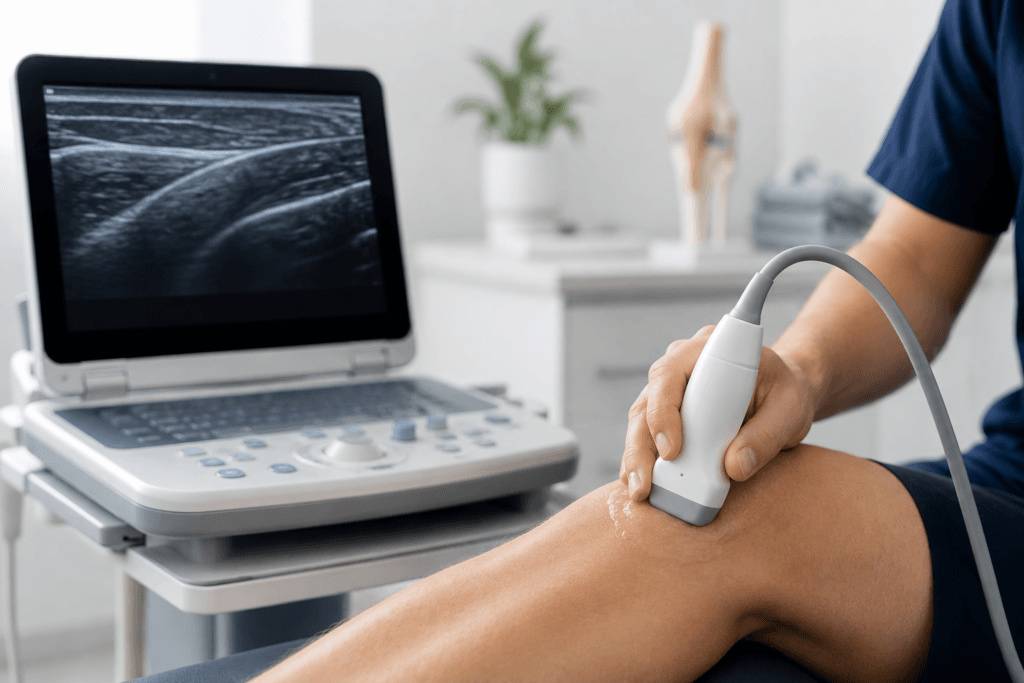
During this podcast, your hosts, Helen O’Leary and Reece Noble talk with Chris about what diagnostic ultrasound is. They also look at how this advanced skill links into a clinical diagnosis and physiotherapy rehab. Importantly they discuss when it may be appropriate to use and if you should get one!
What Our Experts Say
One of the most important points from this episode is that imaging should help answer a clinical question rather than be viewed in isolation. An ultrasound may provide useful information about the tissue involved, but rehabilitation still needs to reflect the person’s symptoms, movement, strength and individual goals. In clinical Pilates, scan findings can inform the programme, while the movement assessment helps us decide which exercises are appropriate and how they should be progressed.

Key Takeaways
- Diagnostic ultrasound should complement a clinical assessment – A scan can provide additional information, but it is most useful when considered alongside your symptoms, medical history and physical examination.
- Scan findings need to match the person’s experience – Changes visible on an ultrasound do not always explain someone’s pain, so the results should be interpreted within the wider clinical picture.
- A more accurate diagnosis can guide rehabilitation – Understanding which tissue may be involved can help the physiotherapist choose a more appropriate treatment and exercise plan.
- Ultrasound can connect assessment and rehabilitation – When scanning is integrated into a physiotherapy appointment, the findings can be used to inform the next stage of treatment rather than remaining separate from it.
- Not every injury requires a scan – Diagnostic ultrasound is most valuable when the result is likely to clarify the diagnosis or change how the condition is managed.
Join the newsletter
Good news stories, exercise tips and short classes. One email a month.
FAQs
1. What can a musculoskeletal ultrasound scan detect?
Musculoskeletal ultrasound can be used to assess soft tissues close to the skin, including tendons, muscles, ligaments, joints and bursae. It may help identify problems such as tendon tears, inflammation, fluid collections and some muscle injuries.
2. Is diagnostic ultrasound safe?
Ultrasound uses high-frequency sound waves rather than X-rays, so it does not expose you to ionising radiation. Medical ultrasound is considered safe when it is carried out for an appropriate clinical reason by a suitably trained professional.
3. Does a musculoskeletal ultrasound scan hurt?
The scan itself should not be painful. Gel is placed on the skin and a handheld probe is moved across the area being examined. You may feel some discomfort if the practitioner needs to press over an already painful area.
4. Do I need to prepare for a musculoskeletal ultrasound?
Most musculoskeletal ultrasound scans require little or no preparation. Wearing loose, comfortable clothing that allows the affected area to be exposed can make the examination easier.
5. Is an ultrasound scan better than an MRI?
Neither scan is automatically better in every situation. Ultrasound can examine superficial tendons, muscles and nerves in real time and may allow the practitioner to assess the tissue while you move. MRI can provide detailed images of deeper structures, bones, joints and a wider anatomical area. The most suitable scan depends on your symptoms and the clinical question being investigated.
Feeling Inspired?
If you want to experience the Complete difference and discover the benefits of one-to-one or small group Pilates, book a session at one of our London or Norfolk studios today. Not able to make it to one of our studios? We've got online options to suit you anywhere, anytime.
Our physiotherapist-led Pilates studio in West London, our North London Pilates studio, our Pilates studio in London City, and our Norfolk Pilates studio in East Anglia, offer a highly tailored approach to your Pilates training. Whether your goal is to manage a health condition, rehabilitate from an injury or to improve your strength and fitness, Complete Pilates is the studio for you.
Education is Key
These blogs are designed to give information to everyone, however, it is important to remember that everyone is different! If you have not seen one of our therapists and have any questions about injuries, what you have read or whether this may be useful to you, please just ask. We are more than happy to help anyone and point you in the right direction. Our biggest belief is that education is key. The more you understand about your injury, illness and movement, the more you are likely to improve.
If you are not sure whether this is for you, simply get in touch. We are here to help!
Published 14 Sep 2020 · Updated 4 Aug 2026