
Different Types of Pilates Equipment Guide
As with other activities, Pilates utilises many types of equipment that play a role in defining Pilates and the associated benefits. The founder of Pilates, Joseph Pilates, is responsible for creating the core principles of Pilates as well as some of the core Pilates equipment, which was referred to as ‘apparatus’. Some of the original pieces of equipment are still used today, such as the Reformer, Cadillac, Wunda Chair and the Ladder Barrel.
Pilates has grown in popularity over the years. The global Pilates and yoga industry was valued at $152.3 billion in 2023 and is expected to reach a value of $377.1 billion by 2032. This is down to a number of contributing factors, from increased health awareness, a conscientious younger generation, higher disposable income and the prevalence of obesity, to name a few. As Pilates has become more widely practised, people are increasingly likely to encounter a range of equipment in studios, gyms and home workouts.
Pilates equipment is used to support, challenge or guide movement and varies from smaller, portable pieces to many large pieces of apparatus. Each type of Pilates equipment has a different purpose. Some pieces use springs and moving platforms to provide assistance or resistance, while others offer support, tactile feedback, instability or additional load.
In this article, we will take a look at the 11 Pilates equipment types you may encounter in your Pilates class. This will enable you to get a better understanding of the different types of Pilates equipment and the classes most suitable to your preferences and goals.
Key Takeaways
- There is a wide range of Pilates equipment - from large machines such as the Reformer and Cadillac, to small props such as the foam roller and soft ball. Each piece of equipment has unique benefits and serves specific functions.
- Pilates equipment enhances accessibility and challenge - Pilates equipment—ranging from small props like resistance bands to larger apparatus like the Reformer and Cadillac—can be used to either support or intensify exercises. This makes Pilates adaptable for beginners, athletes, older adults, and people recovering from injury.
- Equipment-Based Pilates encourages better functional movement - Pilates with equipment often mimics real-life movement patterns, such as pushing, pulling, and gripping. This makes the exercises more functional and relevant to daily activities compared to mat-only workouts, improving overall movement quality.
- Equipment Adds Variety, Engagement, and Motivation - Using different props and apparatus keeps workouts fresh and stimulating. The tactile and interactive nature of equipment (e.g. pulling straps, pressing pedals) increases sensory feedback, which improves technique and often makes sessions feel more fun and rewarding.
What Are the Main Types of Pilates Equipment?
Large Pilates Apparatus
Large studio equipment includes the Reformer, Cadillac, Trapeze Table, Wunda Chair and Ladder Barrel. These pieces often use springs, pedals, bars, straps or curved surfaces to support and challenge movement.
Small Pilates Props
Small props for Pilates include resistance bands, the Magic Circle, foam rollers and Pilates balls. They are portable and can be added to mat or equipment-based exercises to provide resistance, support, feedback or instability.
Essential Mat Pilates Equipment
A supportive Pilates mat is the main piece of equipment needed for mat-based practice. Cushions, small balls and bands can then be added depending on the exercise and individual needs.
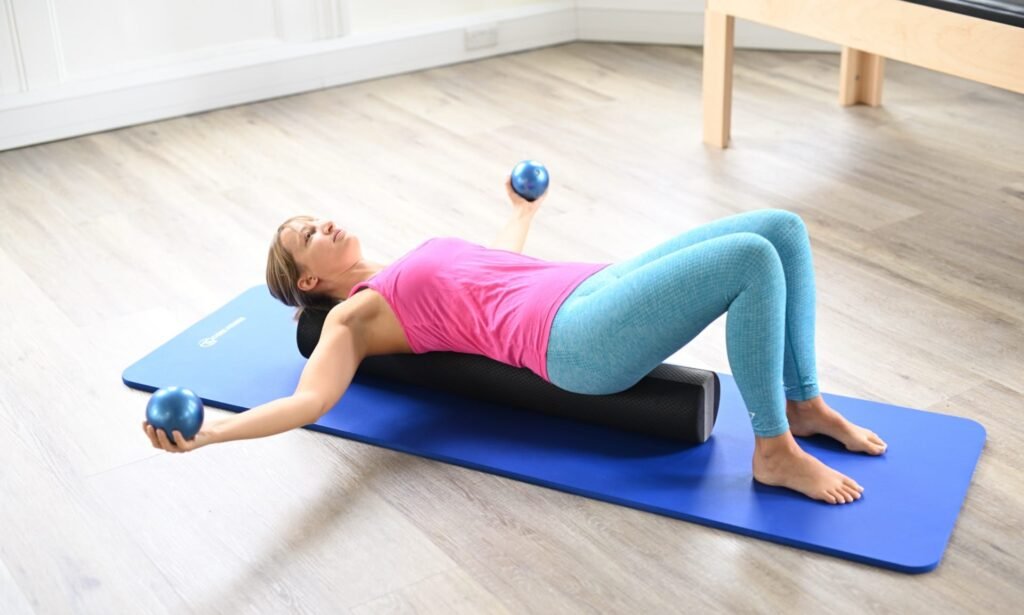
11 Different Types of Pilates Equipment
| Equipment | Types | Main purpose | Commonly used for | Home or studio |
| Pilates mat | Essential equipment | Cushion and support | Mat Pilates | Home and studio |
| Magic Circle | Small prop | Resistance and feedback | Arms, legs and core | Home and studio |
| Resistance band | Small prop | Adjustable resistance | Strength and alignment | Home and studio |
| Reformer | Large apparatus | Spring resistance and support | Full-body Pilates | Mainly studio |
| Cadillac/Trapeze Table | Large apparatus | Support and movement variety | Rehabilitation and advanced work | Studio |
| Pilates Chair | Large apparatus | Strength and balance | Standing and seated work | Mainly studio |
| Ladder Barrel | Large apparatus | Spinal mobility and support | Extension and side bending | Studio |
| Foam roller | Small prop | Mobility and instability | Release and strengthening | Home and studio |
| Stability ball | Small prop | Instability, balance and full-body support | Core, mobility and strength | Home and studio |
| Over ball | Small prop | Targeted support, feedback and activation | Core control, pelvic stability, posture and rehabilitation | Home and studio |
| Spine corrector | Small apparatus | Support for spinal movement and alignment | Spinal mobility, abdominal work, side bending and posture | Home and studio |
1. Pilates Mat
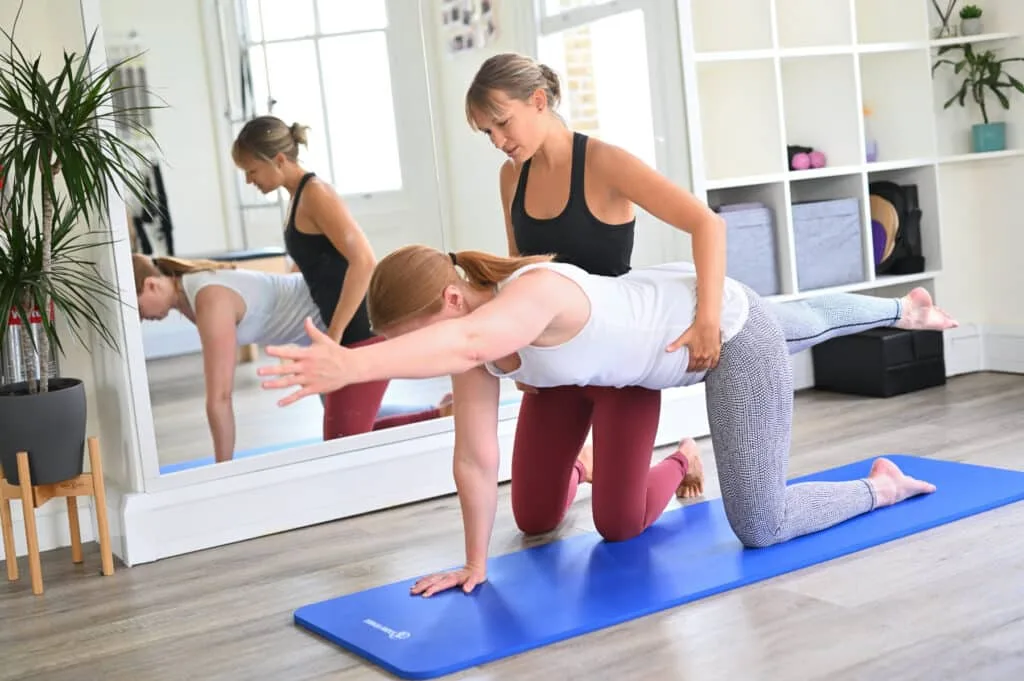
Pilates mats are often confused with Yoga mats;, however, there are some differences to be aware of. For example, a Pilates mat is typically thicker, may be larger in size and has slicker surfaces.
Generally speaking, many exercises within the Pilates repertoire are completed on your back or stomach, as well as requiring students to perform spinal rolling exercises. These types of exercises require a thicker mat to support and cushion the body.
Mats are typically used in a mat Pilates class, the most accessible form of Pilates, which teaches students the fundamental movement techniques as well as challenges them with advanced movements.
2. Magic Circle or Pilates Ring
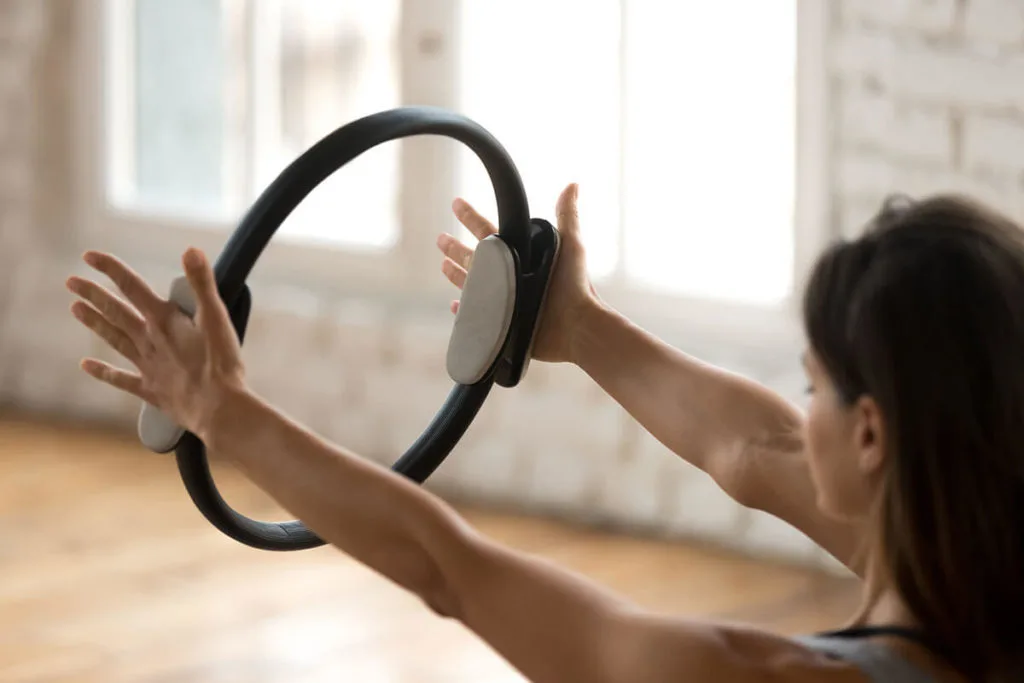
The magic circle, also known as the Pilates ring, is a small and portable piece of equipment invented by Joseph Pilates.
This type of Pilates equipment is a lightweight circular resistance prop which is used in both mat and reformer classes.
The prop is designed to provide varying amounts of resistance in order to increase support or offer greater challenge during exercise. Resistance will depend on how hard it is being squeezed, but bear in mind it is not designed to be squeezed to death!
The magic circle can be incorporated into many exercises, including dead bugs, hip extensions, fire hydrants, and press-ups to either assist the movements or make them harder.
For more information, please read our guide to The Magic Circle.
3. Pilates Band or Resistance Bands
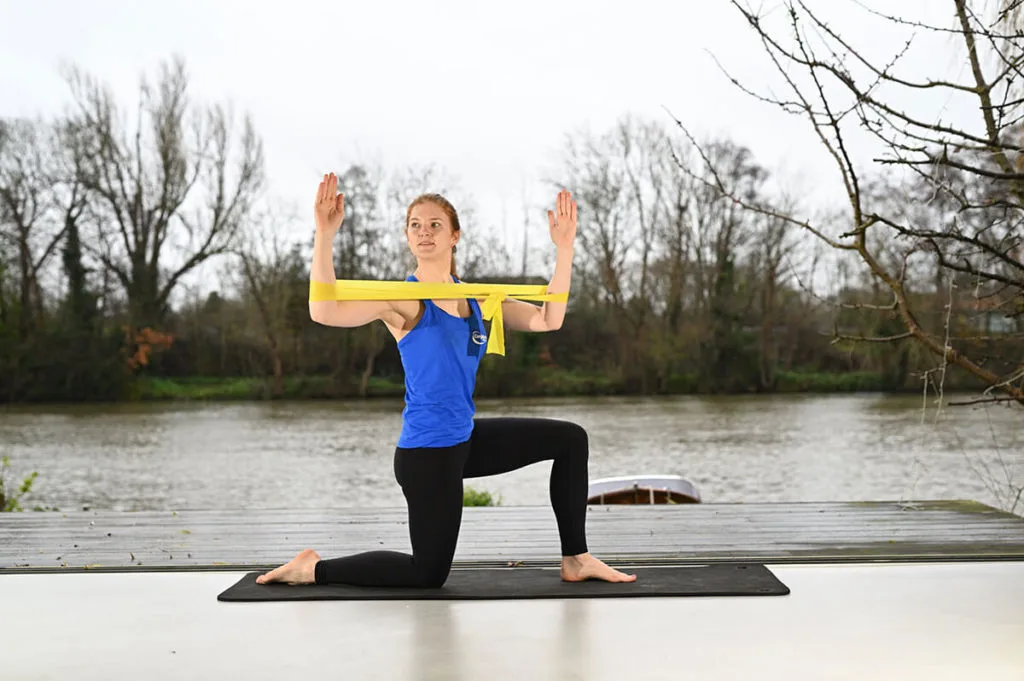
Another small prop is the resistance band, also known as the Pilates band. Similar to the magic circle, the resistance band offers resistance in exercises to make them more challenging or assistive.
The resistance band comes in varying lengths and resistance levels, from light, medium and heavy. Benefits include:
- Increase assistance with exercises by providing feedback
- Increase the difficulty of exercises
- Help to build strength
- Increase the variety of mat exercises
For more information, please read our guide on the Pilates band.
4. Pilates Reformer
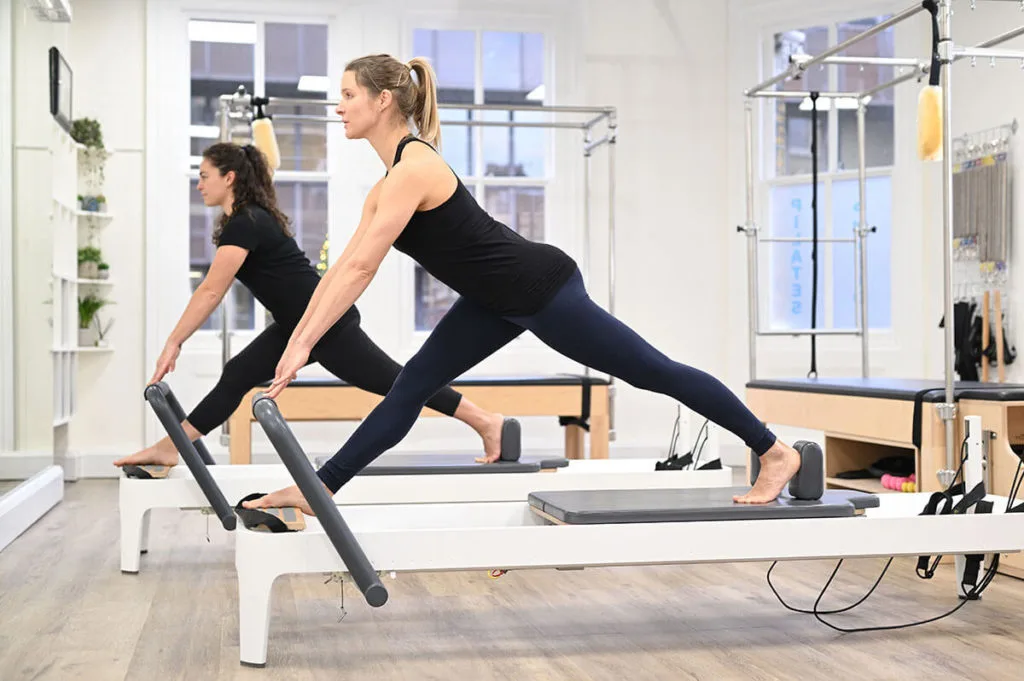
The Pilates reformer is one of the original types of equipment invented by Joseph Pilates when he was working at a hospital during the First World War. He originally made the reformer from a bed frame and springs to help patients strengthen their muscles. The reformer is also arguably the piece of equipment which plays the biggest role in distinguishing Pilates.
The Pilates Reformer is a large piece of apparatus consisting of a rectangular frame made from either wood or metal. A carriage (which is a padded platform) sits on the frame attached to runners enabling it to slide along the length of the frame. At one end of the frame is a foot bar and at the other are two long ropes with handles attached to pulleys. The tension of the reformer can be adapted by adding or removing springs which attach the carriage to the frame.
The Pilates reformer can be used when you are lying down, on your side, standing, kneeling or on all fours and is designed to help:
- Mobilise the spine
- Assist your movements
- Strengthen the abdominals and whole body
- Improve technique
- Increase difficulty
- Promote better balance
- Enhance coordination
- Improve mobility
- Increase flexibility
- Aid range of movement
For more information, please read our guide on Reformer Pilates.
5. Cadillac or Trapeze Table
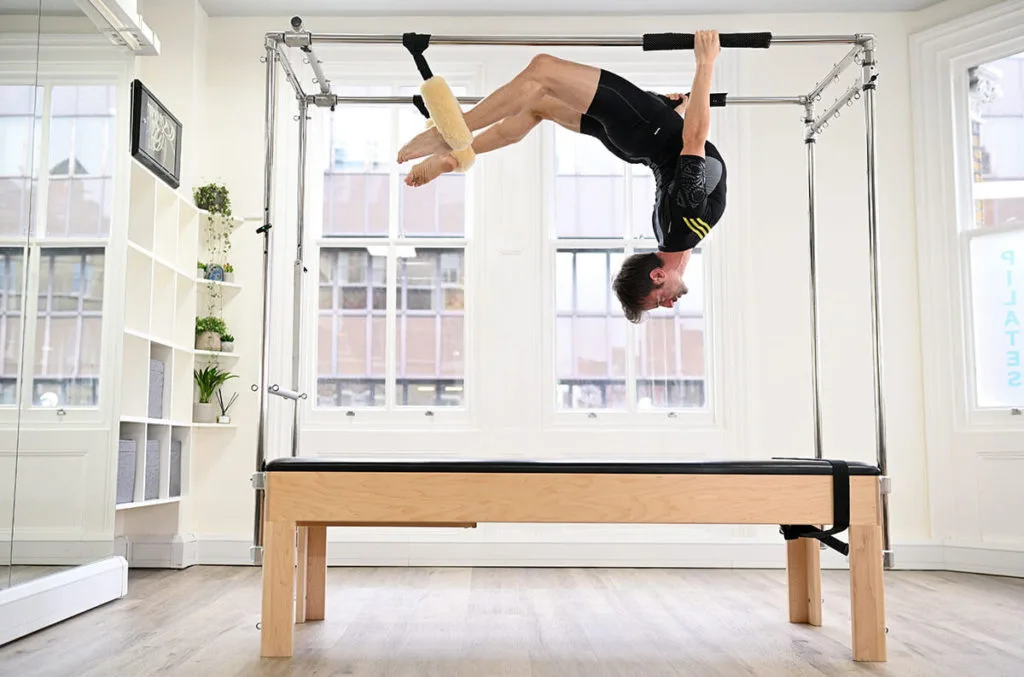
The Cadillac, also known as the trapeze table, is the most versatile and supportive piece of Pilates Equipment. The Cadillac looks similar to a four- poster bed; the apparatus comprises a leather- clad table and a metal frame with four uprights positioned in each corner.
Attached to the frame are the trapeze bar, fluffy straps, push bar and cross bar used for a variety of exercises in order to provide assistance or resistance in the movement.
The trapeze table can be used for basic exercises usually completed in mat Pilates as well as more advanced Pilates exercises, whether it be lying down, kneeling or in a standing position.
The Cadillac has a number of benefits, including:
- Aid rehabilitation
- Increase the complexity of exercises
- Improve stability
- Promote balance
For more information, please read our guide to the Pilates Trapeze Table.
6. Pilates Chair
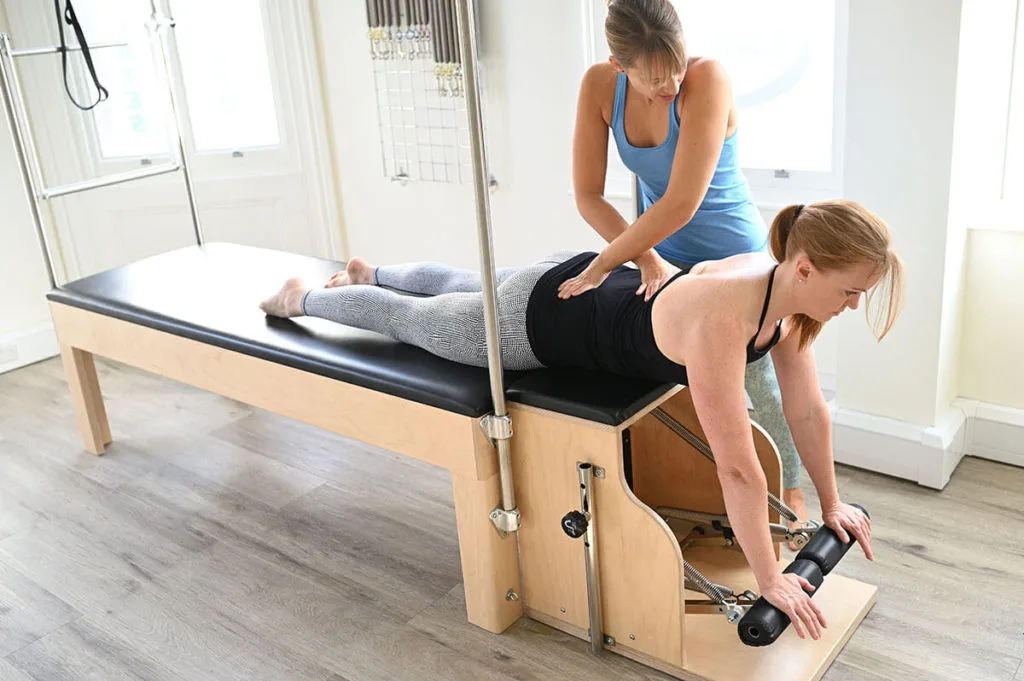
The Pilates chair, also known as the Wunda chair, is another original piece of Pilates equipment invented by Joseph Pilates.
This type of Pilates equipment is designed to be compact and comprises a (typically wooden) box with a padded seat and a pedal attached by springs. The springs allow for tension to be increased or decreased depending on the exercise and desired level of intensity.
Exercises using the Pilates chair are typically completed in a standing or seated position, but can also be performed on your front or back.
The Pilates chair is great for a number of reasons, including:
- Injury rehabilitation
- Enhance sports performance
- Increase strength
- Promote balance
- Improve foot control and strength
For more information, please read our guide to the Pilates Chair.
7. Ladder Barrel or Barrel
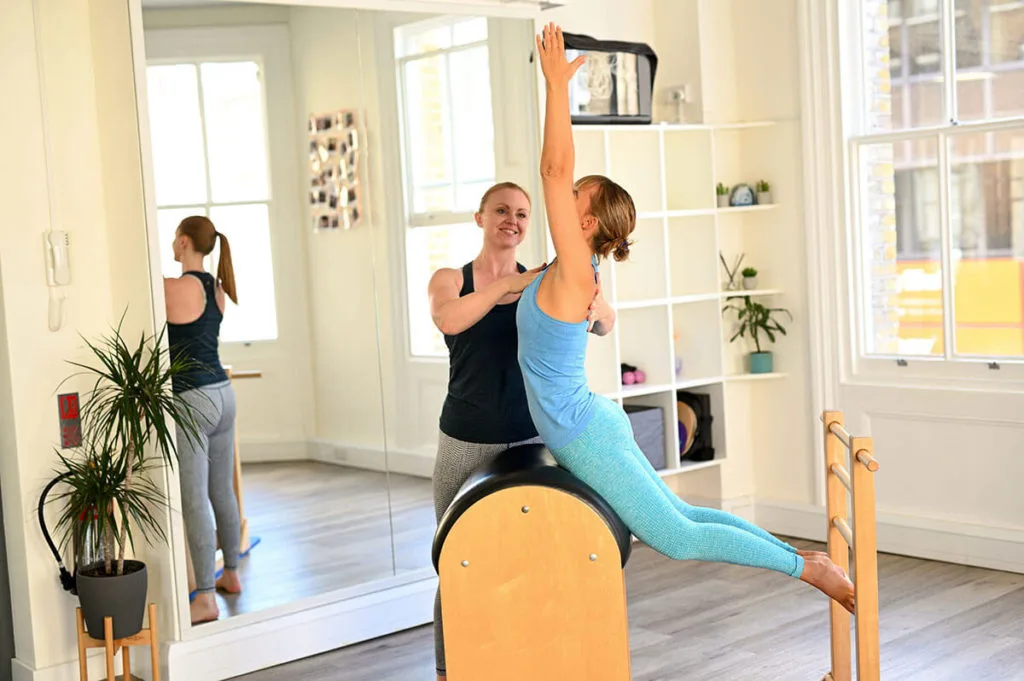
The Ladder Barrel is an original piece of Pilates equipment designed by Joseph Pilates using an empty beer keg.
The Ladder Barrel consists of a wooden ladder with rungs and the barrel which is padded and leather-clad. The two components are attached by a sliding frame base.
The Ladder Barrel is designed to encourage the spine to move into extension and flexion which helps to improve range of movement. This type of Pilates equipment can also be used for ab and oblique exercises.
For more information, please read our guide to the Ladder Barrel.
8. Foam Roller
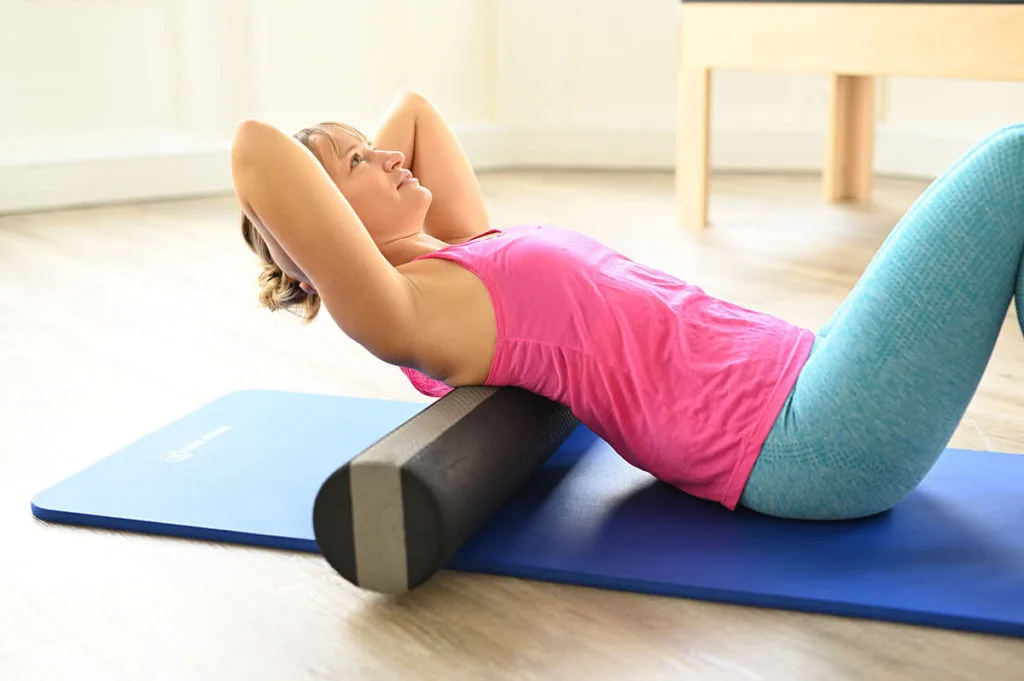
The foam roller is a classic small prop used within Pilates and is a popular piece of equipment for its versatility, which lends itself to both self-massage and exercise.
Foam rollers are long, cylindrical tubes made from foam.
By sitting or lying on the floor and placing the foam roller underneath the area of the body you want to release, you can give yourself a massage by applying pressure. This is particularly important to reduce the risk of injury as well as aid recovery. Even for less active individuals who find themselves desk-bound most of the day, the foam roller can be ideal to relieve an achy shoulder or a sore lower back.
They can also be used in exercise and mobilisation, for example, abdominal exercises or to behave in a similar way to the ladder barrel.
Benefits of the foam roller include:
- Help alleviate tension
- Aid recovery
- Enhance restoration
- Increase the range of movement
- Build strength
- Improve coordination and control
For more information, please read our guide to the Foam Roller.
9. Stability Ball
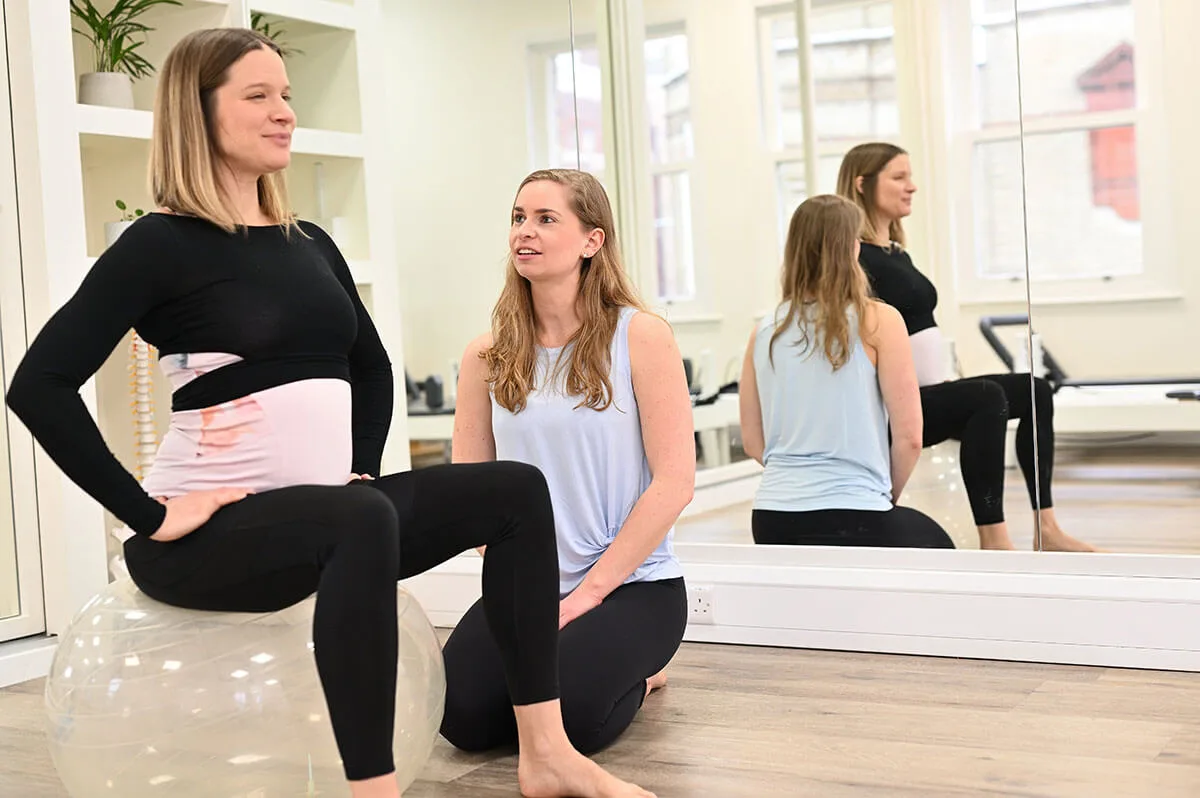
The stability ball is one of the most versatile types of Pilates equipment. It is also known as a fitness, gym or Swiss ball made from soft elastic and filled with air.
In Pilates, this type of equipment is used for equipment-style movements, but on the mat, which incorporates the whole body, such as reverse abs. It can also be used for strength-building exercises such as hamstring curls and hip thrusts.
Benefits of the stability ball include:
- Increased muscle activation
- Improves balance and coordination
- Enhances mobility
- Build and develop strength
- Challenges your strength and control in all directions
- Assists movements in clients who are pregnant
For more information, please read our guide to the Stability Ball.
10. Over Ball
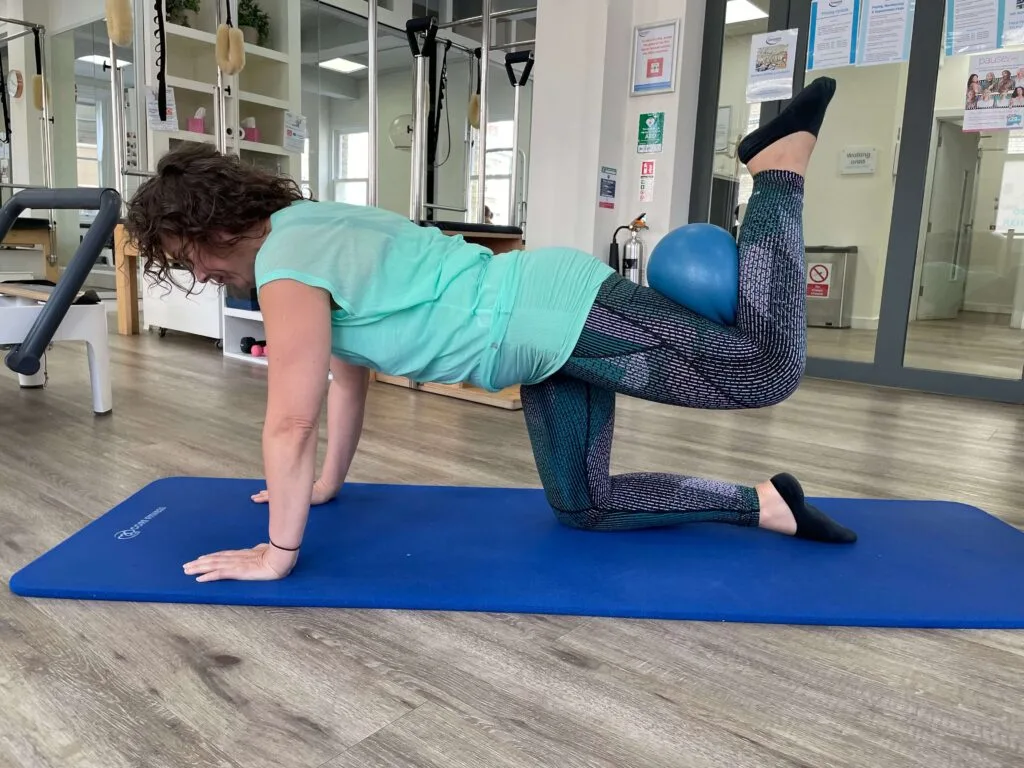
The Over Ball is a soft, air-filled ball that can be used partially or fully inflated, depending on its intended use.
The Over Ball is a useful addition to both equipment and mat exercises. In contrast to the stability ball, the Over ball is particularly suited to targeted activation and strengthening work.
Benefits of the Over Ball include:
- Useful for feedback, support and targeted activation
- Strengthen additional muscles during exercise (e.g. pelvic floor or inner thighs)
- Encourage good alignment and form
- Improve balance
- Relax neck tension during exercises
11. Spine Corrector
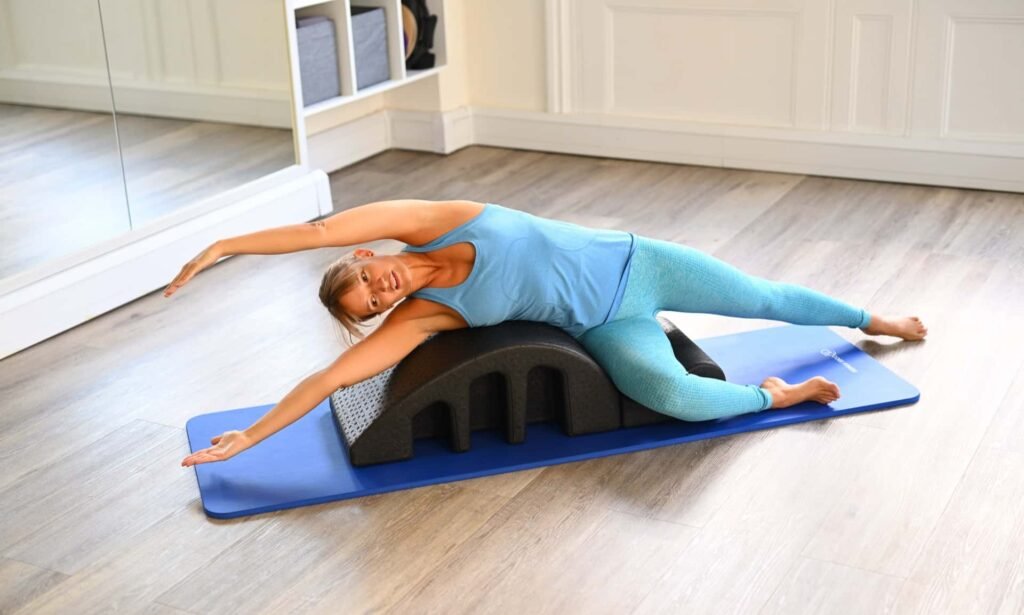
A spine corrector is primarily used to assist spinal movements and for abdominal exercises. It has a less dramatic curve than the barrel, reducing the possible range for the body to move in. The gentle curve is good for beginners or someone with an injury.
Benefits of the spine corrector include:
- Improve mobility, flexibility and strength of the spine
- Provide spine support and encourage even movement
- Make exercises more accessible to beginners, people with injuries or pregnant women
What Are the Benefits of Using Pilates Equipment?
Support
One of the great reasons to use Pilates equipment is that the equipment can actually support you with more challenging exercises. The original Pilates mat exercises are quite advanced, and this means that not everyone can perform them well. Consequently, they may not get the most benefit out of them. If you are a beginner, or you are returning to exercise after illness or injury, you need modifications to exercise that are appropriate for your level.
The trapeze table has a high, wide, stable surface, making it easier to get onto compared to a mat on the floor. There is more room to turn over, compared to, say, the reformer.
The soft Pilates ball is a great addition if you are struggling with certain exercises, such as the seated roll back. Placing the ball behind your pelvis provides a supportive surface for you to roll back onto, so your abdominal and hip flexor muscles don’t have to do as much work.
Challenge
Pilates equipment is very versatile. Not only can it be used to modify exercises to make them easier, but it can also be used at the other end of the spectrum - to make things harder! The large Pilates equipment, in particular, is great for progressing exercises. The equipment uses springs as resistance to make basic movements more of a strength challenge. The equipment can also be used to provide a stability challenge - the moving carriage on the reformer can be used to make a plank more dynamic and less stable, for example.
Variety and Novelty
Human brains are designed to get bored quickly, so if you’ve been doing mat Pilates for a while, you may find yourself losing enthusiasm once you have got used to the key exercises.
Adding small pieces of equipment to the class can add interest - for example, the small Pilates ball has a pleasing texture and soft, bouncy feel, so it stimulates the tactile part of the nervous system. The small and large Pilates balls have a pleasing shape, and are associated with play, so they stimulate the visual and vestibular systems but also tap into the reward centres of the brain.
Lying on a reformer and pulling straps to move the carriage you are on provides more interesting feedback than lying on a mat doing the same movements with your arms. The minute most people get on a reformer and experience the movement, they either smile and say “ this is so relaxing!” or “this is so fun!”.
Increased Functional Relevance
Pilates using equipment can more closely represent the way we move in everyday life. For example, holding weights, a magic circle or holding on to a bar on the trapeze table all involve some type of grip. We often move our arms in daily life for the purpose of manipulating objects, as opposed to moving them purposelessly in space.
Equally, most of the time when we are moving our legs, we are using the feet to push away from another surface, such as when we are walking, going upstairs, or getting up out of a chair. The large Pilates equipment has a variety of footplates, bars and pedals that provide surfaces to place the feet and push from during Pilates exercises.
External Rather Than Internal Focus
Often during Pilates we use what are called “cues”. These are little tips to help you get more from an exercise. Pilates is famous for using lots of cues that require you to use your imagination to conjure up a visual picture, or to pay attention to the sensations at different parts of the body. These can be thought of as more internal cues.
Not everybody finds internal cues easy to grasp, and finds external cues more helpful. External cues refer to objects outside the body - for example, instead of saying “move your feet apart”, saying “move your foot towards the wall” provides a direction and target that may be easier to understand.
Holding on to various parts of equipment or being able to move a part of the equipment from one place to another gives an external focus to your movement.
What Do Our Experts Say?
The brilliance the Pilates equipment offers, are endless possibilities. This means there is always an appropriate option to strengthen safely no matter the injury, structural changes such as Scoliosis, throughout pregnancy, extra aid for the older adult, or for example someone with Parkinson's disease. The use of equipment helps to tailor the program to the client's needs and achieve results.’

What Pilates Equipment Do Beginners Need at Home?
You can do Pilates at home with a little or a lot of equipment! You do not need to buy every Pilates prop to begin practising at home. Start with the equipment that supports the exercises you are most likely to do.
The key piece of equipment would be an exercise mat. Mats that are specific to Pilates are thicker and more spongy than a yoga mat, because of the number of exercises that are performed lying on the back - this is more comfortable for your spine.
To help you with optimal body alignment, a head cushion is a useful addition to your home setup.
The overball, magic circle and a set of resistance bands are a great next addition to your Pilates home set-up.
For added challenge, and if you have the space, a foam roller and some light dumbbells (1 - 2kg to start) can also be used.
Which Type of Pilates Equipment Is Right for You?
For Beginners
A mat, a small ball and a resistance band can provide a simple introduction, while supervised equipment Pilates may make some movements more accessible.
For Building Strength
The Reformer, Chair, resistance band and Magic Circle can all add resistance, although the appropriate option depends on the exercise and current ability.
For Mobility
The Ladder Barrel, Spine Corrector, foam roller, and stability ball can support mobility-focused movements.
For Rehabilitation
The most suitable equipment depends on the condition, symptoms and assessment. The Cadillac, Reformer and small props can all be adapted under professional guidance.
For Home Practice
Mats, bands, rings, balls and foam rollers are usually more practical than large apparatus.
Which Pilates Class Is Right For You?
Now that you have a better understanding of the types of Pilates equipment you may come across, now is the time to decide which Pilates class is right for you.
Having been created back in the 1920s, Pilates has evolved over time, creating variations of Pilates which offer specific health and physical benefits.
Pilates classes include:
- Classical Pilates
- Mat Pilates
- Contemporary Pilates
- Reformer Pilates
- Clinical Pilates
To find the most suitable class for you, read our guide to the types of Pilates here.
Book A Pilates Class With Complete Pilates
Try out the different types of Pilates equipment with Complete Pilates and book a session at one of our London or Norfolk studios today. Not able to make it to one of our studios? We've got online options to suit you anywhere, anytime.
Our physiotherapist-led Chelsea Pilates studio, our Angel Pilates studio, our Pilates studio in London City, and our Norfolk Pilates studio in East Anglia, offer a highly tailored approach to your Pilates training. Whether your goal is to manage a health condition, rehabilitate from an injury or to improve your strength and fitness, Complete Pilates is the studio for you.
Related Blogs:
- Beginner’s Guide to Reformer Pilates
- The Magic Circle: Pilates Ring Exercises & Benefits
- An introduction to the Pilates chair – What is it, how does it work and Chair Pilates exercises?
- An introduction to the Pilates trapeze table – what is it? Exercises and workouts
- The Pilates ladder barrel and Pilates spine corrector exercises – What are they? How do they work?
- What is a Pilates cadillac and what are the benefits?
FAQs
What Is the Most Common Type of Pilates Equipment?
The Pilates mat is the most accessible piece of equipment, while the Reformer is one of the most recognisable forms of large studio apparatus.
Do You Need Equipment to Do Pilates?
No. Pilates can be practised on a mat using body weight alone. Equipment can then be added to provide support, resistance, feedback or variety.
What Pilates Equipment Is Best for Beginners?
A supportive mat, a small ball and a light resistance band are useful starting points at home. In a studio, the best equipment will depend on the individual and the guidance of the instructor.
Can You Buy Pilates Equipment for Home Use?
Small props such as mats, bands, rings, balls and foam rollers are practical for most homes. Large apparatus requires significantly more space, instruction and investment.
Education is Key
These blogs are designed to give information to everyone, however, it is important to remember that everyone is different! If you have not seen one of our therapists and have any questions about injuries, what you have read or whether this may be useful to you, please just ask. We are more than happy to help anyone and point you in the right direction. Our biggest belief is that education is key. The more you understand about your injury, illness and movement, the more you are likely to improve.
If you are not sure whether this is for you, simply get in touch. We are here to help!
Published 11 Mar 2024 · Updated 3 Aug 2026