Basic Bridge Exercise – Your Step By Step Guide With Video!
If you suffer from back pain, sit at a desk all day, or run or walk a lot then the bridge exercise is for you!
It’s simple but effective as it helps to mobilise the spine and strengthen the entire back of your body including hamstrings, core and glutes all of which, when weak, can contribute to knee, ankle, and lower back pain.
The bridge exercise is a great exercise to do as part of your warm-up routine before exercising, if you want to improve the functionality of your training, or if you want to strengthen your postural muscles (those deep ones in your abdominals, pelvis and back).
In this article, we’ll be discussing:
- What is a bridge exercise?
- How to do a bridge exercise?
- What are bridge exercise benefits?
- Who is the bridge exercise suitable for / not suitable for?
- Bridge exercise variations
What Is A Bridge Exercise
The basic bridge exercise, or the glute bridge exercise as it’s also known, is one of the best exercises to do if you have back pain, bad posture or if you have tightness in the front of your hips caused by walking, running or prolonged sitting.
It's a great way of stretching out the hip flexors, strengthening the glutes muscles and hamstrings and improving core stability as it engages those all important core muscles.
The glute bridge exercise requires no equipment and can be carried out whilst laying on a fitness/Pilates mat, or a towel at home or gym. The movement shouldn't be rushed so you can feel what’s going on in your body and work out if you are compensating elsewhere or moving asymmetrically.
How To Do The Basic Bridge
Basic Bridge Exercise Tips
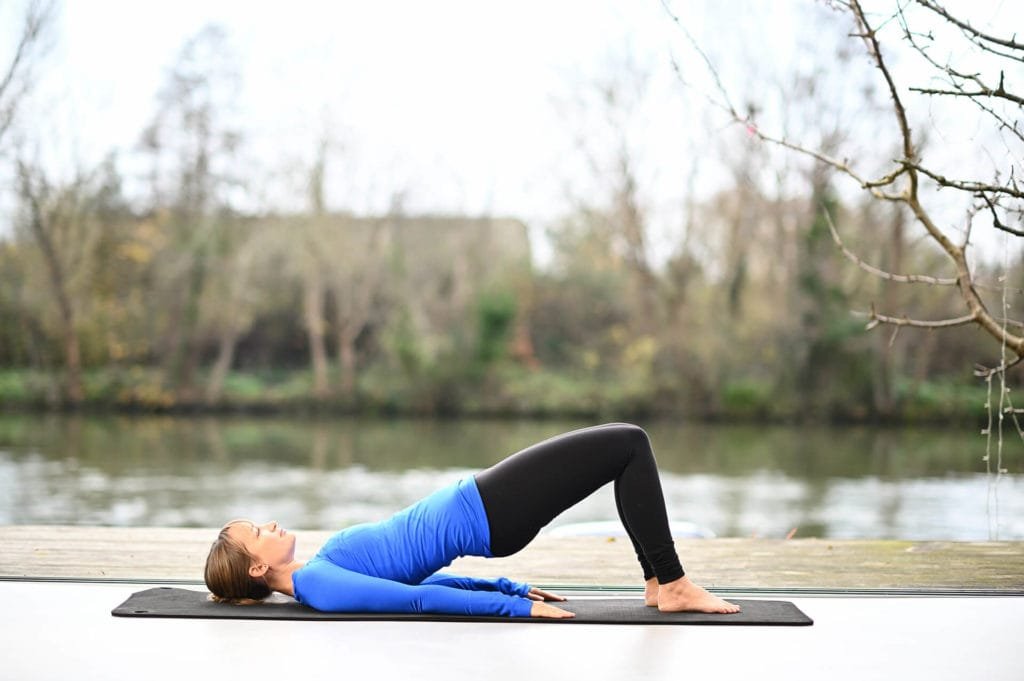
- Start by lying on your back with your knees bent and feet flat on the floor.
- Have your feet a comfortable distance away from your glutes and feet as wide as your sitting bones.
- Start with a few pelvic tilts to feel how your entire spine moves and how the weight can drop into your feet.
- As you exhale, press down into your feet, and allow your hips and back to come up.
- Pause at the top as you inhale and then exhale to return to the floor.
- Keep going and this time, stand into your heels and imagine that your knees are reaching over your feet as you are moving up. To come back down, pull your heels towards your glutes and slow your spine down, trying to lay it along the mat.
- Make sure you release your sit bones completely at the bottom of the movement.
- Try to keep your shoulder blades on the floor as you do this so that you are not going into extension in your back.
- The further away your feet are from your glutes the harder this will be on your hamstrings.
Basic Bridge Exercise Benefits
The basic bridge exercise is one of those exercises that has a number of benefits and is used a lot in clinical Pilates classes because it is simple to do and is safe for pretty much everyone! As already mentioned, it’s especially great for increasing strength, stability and function of the hips, back, glutes and core.
Basic Bridge Exercise Benefits:
- It works the entire back line, glutes and the core
- it reduces hip, knee and back pain
- It opens out the front of the hips and lengthens the hip flexors
- It improves stability in the obliques
- It improves overall strength and posture
- It improves performance in sport - strong glutes and hamstrings can help you to run faster and jump higher!
- It's also a low impact move so it’s ideal for those with ankle. knee or hip or back discomfort
Who Is Basic Bridge Exercise Suitable For?
The basic bridge exercise is suitable for anyone looking to strengthen the core or glute muscles. Understanding how to do a basic bridge well can help you progress to making it more specific and dynamic as an athlete!
The bridge exercise is also suitable for anyone just looking to improve their general health and mobility in order to carry out day-to-day activities. People who are desk based for most of the day or who lead a sedentary lifestyle will also benefit from the bridge exercise as it helps stretch out those hip flexors which often become weaker from sitting.
Who Is The Basic Bridge Exercise Not Suitable For?
If you have recently had surgery or have an acute injury involving your back, abdomen or pelvis then you should ask your physio before doing this exercise. If you have been seen as an inpatient, do not be surprised if they give this exercise to you as one of the first things to do! If you are in the latter stages of pregnancy, this may not be suitable for you so again speak with your physio or clinical Pilates instructor. If you have recently given birth, combine this exercise with your pelvic tilts and move as you feel able.
If you are getting pain in this exercise, please get in touch with us as there are lots of ways to modify it to help you.
Bridge Exercise Variations
There are several other ways to develop the basic bridge exercise in order to target different muscle groups and challenge your body further. These include:
- Double Leg Bridge On Your Toes
- Single Leg Bridge
- Glute Bridge March
Double Leg Bridge On Your Toes
- This exercise is again on 2 legs but instead you are loading through the front of your foot. This is really important as a lot of what we do is through this part of our foot so will help the movement be more functional.
- With your feet up on a step or chair, have the balls of your feet (not toes) on the edge.
- As you exhale, allow the balls of your feet to start to press down and heels to start to lift.
- Reach your knees over your toes and come up into the bridge movement. Your shoulder blades should remain on the floor.
- Pause at the top to breath in and then slow yourself down as you again pull your heels to your bottom and lay your spine back along the mat.
- Keep repeating this, you should feel your calf get more involved than when you were on your heels.
- As you are starting from greater hip flexion, you will have a bigger range of movement to go through. This again makes it more functional for those who sit a lot or run.
Double Leg Bridge On Your Toes - Exercise Tips
- You should be able to wiggle your toes throughout the movement! This means that you are working your ankle muscles properly rather than just gripping with your toes.
- Allow your body to feel like it is falling off your legs. This will make your legs do more work and allow your spine to move through its range.
- Try not to force ‘each bone down one at a time’, or even come up this way. Our spine doesn’t really move like this and so we are looking for distribution in your movement.
- Keep your heels pulling to your bottom to activate the back of your body.
- Have your hands gently pressing into the floor, palms down to give you some support and activate some of the bigger muscles in your back.
Single Leg Bridge Exercise
- Start lying on your back with both feet on the floor and knees bent. Let one leg come up into table top, this is where you will start.
- As you exhale, press down into your foot to allow your hips and spine to lift.
- Pause at the top and check that your pelvis is level before laying yourself back down again.
- It should feel like you are still laying down each side of your spine at the same rate. This will help ensure your pelvis is level
Single Leg Bridge Exercise - Exercise Tips
- Look down at your thigh which is in table top. This should still be vertical rather than coming across your body. Can you keep your hip bones level when it is vertical.
- Keep using your arms to press. We want your back muscles to work and this will give you some stability as you are building awareness and strength
- If you struggle with hip range of movement, make sure you are on a step so that you have more range to work in.
- Challenge yourself by staying on the balls of your feet rather than your heels!
What Our Experts Say
The bridge is most effective when it is treated as a whole-body movement rather than simply a glute exercise. The feet, legs, pelvis, spine and shoulders all contribute to the movement, and learning to coordinate them can improve both strength and movement awareness. Mastering the basic version first creates a much better foundation for progressing safely.

Key Takeaways
- The bridge is a simple, low-impact exercise that strengthens the glutes, hamstrings, back and abdominal muscles.
- It can help improve hip and spinal mobility, posture and control through the pelvis.
- The exercise is particularly useful for people who sit for long periods, as well as walkers, runners and athletes.
- Bridge variations can increase the challenge by changing foot position, working on one leg or adding more balance and control.
- The movement should feel controlled and pain-free, with modifications used when recovering from injury, surgery or pregnancy.
Join the newsletter
Good news stories, exercise tips and short classes. One email a month.
Conclusion
The bridge is a valuable exercise for building strength through the back of the body while encouraging movement through the hips and spine. It requires no equipment, can be adapted for different ability levels and can be included in a warm-up, rehabilitation programme or regular strength routine.
Good technique is more important than lifting as high as possible. Pressing evenly through the feet, keeping the pelvis controlled and avoiding excessive movement through the lower back will help you get the most from the exercise. Once the basic bridge feels comfortable, progressing to heel raises, marching or single-leg variations can make it more relevant to walking, running and sport.
Feeling Inspired
If you want to experience the Complete difference and discover the benefits of one-to-one or small group Pilates, book a session at one of our London or Norfolk studios today. Not able to make it to one of our studios? We've got online options to suit you anywhere, anytime.
Our physiotherapist-led Pilates studio in Chelsea, our Angel Pilates studio, our Pilates studio in City, and our Norfolk Pilates studio in East Anglia, offer a highly tailored approach to your Pilates training. Whether your goal is to manage a health condition, rehabilitate from an injury or to improve your strength and fitness, Complete Pilates is the studio for you.
Education is key
These blogs are designed to give information to everyone, however, it is important to remember that everyone is different! If you have not seen one of our therapists and have any questions about injuries, what you have read or whether this may be useful to you, please just ask. We are more than happy to help anyone and point you in the right direction. Our biggest belief is that education is key. The more you understand about your injury, illness and movement, the more you are likely to improve.
If you are not sure whether this is for you, simply get in touch. We are here to help!
FAQs
What muscles does the bridge exercise work?
The bridge primarily works the glutes, hamstrings and muscles along the back of the body. It also requires the abdominal muscles, pelvic stabilisers and back muscles to help control the pelvis and spine.
Is the bridge exercise good for lower back pain?
The bridge can be helpful for some people with lower back pain because it strengthens the muscles supporting the hips and spine. However, it should not increase your symptoms, and persistent or severe pain should be assessed by a physiotherapist or healthcare professional. This exercise should not cause you pain and there are a multitude of ways you can adjust the movement so that it doesn't.
How many bridges should I do?
A useful starting point is 8 to 12 controlled repetitions for two or three sets. The right amount depends on your strength, symptoms and goals, so stop before your technique starts to change or the movement becomes painful.
Why do I feel bridges in my hamstrings instead of my glutes?
Your feet may be too far away from your body, or your hamstrings may be compensating for reduced glute strength. Bringing the feet slightly closer, pressing evenly through the whole foot and reducing the height of the bridge may help.
When should I progress to a single-leg bridge?
Progress when you can perform the double-leg bridge with a level pelvis, even pressure through both feet and no pain. The single-leg version requires greater hip, pelvic and trunk control, so it should be introduced gradually.
Published 29 Dec 2021 · Updated 16 Jul 2026