
Glute Bridge March – Your Step by Step Guide with Video!
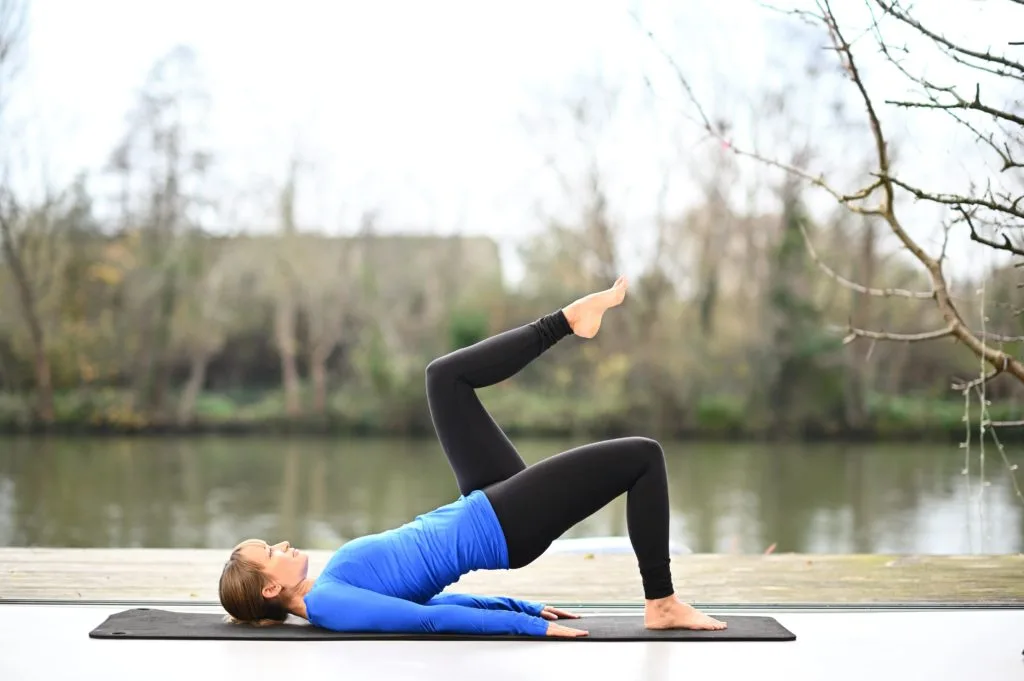
The glute bridge march is one of the best exercises to do if you are a runner who is returning from an injury, or if you suffer from lower back pain in the gym or while out walking. It’s also great if you want to get stronger while stretching out your hip flexors at the same time.
Essentially this is a variation of the standard bridge exercise which incorporates a marching movement giving that extra challenge to the glutes and hamstrings adding in strength, stability and mobility work.
In this article, we’ll be discussing:
- What is the glute bridge march
- How to do the marching bridge exercise
- What are the benefits of the glute bridge march
- Who is the marching exercise suitable for / not suitable for?
What Is The Marching Bridge Exercise
The marching bridge exercise is the stepping stone to a single leg bridge and has it all! Bridging helps open the front of your hips which gives you better hip extension. If you are a runner or walk a lot, this is really important. By getting good hip extension then you will have more power to push forwards. This means your movement will be quicker, and more efficient. If you are returning from an injury this is also one of the stepping stones to moving towards single leg work!
The marching bridge exercise is not an exercise you should rush. Make sure you take your time and practice each rep. Feel what's going on and where compensations are happening. Ensure you engage your core muscles and aim to make each rep better than the previous.
How to do Marching Bridge
- Lie on your back with your arms at your sides; press your heels into the floor and lift your pelvis up until your knees, pelvis, and shoulders form a straight line.
- Hold your bridge while you lift your right knee toward your chest, until your hip is at a 90-degree angle.
- Return the heel to the floor, and lift the left knee.
- Do not let your pelvis sag or your back overarch while lifting and lowering your knees.
- Repeat 4-10 times on each side
Marching Bridge Exercise Tips
- Keep your hip bones level
Knowing your pelvic clock will help with this. If you feel it in your back, see if you can tilt your pelvis towards 12 a little more. Your 3-9 on the clock needs to remain level! - It is all in the feet
Press your heels down into the floor to activate the back of your legs rather than lifting from your back. Your feet should trigger the movement in your hips and spine. By pressing harder into one foot, it also allows the other to lift easier. A great tip for those harder exercises to come. - Let your spine move freely
Rather than peeling off the floor, try to create space. Pull your heels towards your glutes and send your knees over your feet to create space in your hips. Try to go back down by going along the mat rather than just down. - Let your legs do the work
Feel your body hang off your legs. If your shoulder blades are on the floor and you can breathe this will help. - Go for parallel
If your knee is falling across your body when you lift the leg, try to re-stack your pelvis in 3-9 on the clock and pull the leg out. This requires hip differentiation!
Remember, if you are aiming to run, you need to move onto the balls of your feet.
Marching Exercise Benefits
The marching exercise is an essential exercise for athletes and anyone looking for increased strength, stability and function of their hips, lower back and pelvis.
Marching Bridge is great for:
- working the core and glutes
- stretching out the hip abductors, glutes, and hamstrings.
- improving stability in the obliques, and quadriceps
- improving overall strength and posture
- easing lower back pain.
Who Is The Marching Bridge Exercise Suitable For?
The glute bridge march exercise is suitable to do as a warm up before a run, bike or workout or as a key exercise as part of your main strength and conditioning workouts.
They are also great for golfers as they help strengthen the glutes which in turn helps to keep your pelvis stable and enable you to stay in the correct position throughout a swing. Additionally, they can help people who suffer with lower back or knee pain strengthening the muscles supporting these areas.
Who Is The Marching Exercise Not Suitable For?
It may be necessary to avoid the marching bridge exercise if you are in the later stages of pregnancy, have just given birth, if you are healing from surgery or an injury involving your back, abdomen or pelvis, hips, joints, knees, or ankles. It’s also best to avoid if you have an abdominal hernia or another condition or injury in that area.
Do make sure you ask your doctor or speak to an exercise specialist such as a Clinical Pilates Instructor for your own individual advice and modifications if needed.
Why Do The Marching Bridge Exercise?
As already highlighted in this article, the marching glute bridge not only helps to improve strength in your glutes, but it will also help stabilize your hips and pelvis, which is so important when it comes to functioning optimally in both day-to-day life and sport and preventing pain in short and long term.
If you are new to fitness or worried about starting a new exercise such as marching bridge, at Complete Pilates we would advise you to always speak to your doctor or physio, or clinical Pilates instructor here at Complete Pilates who are all trained to safely treat and create manageable plans to keep you healthy.
Key Takeaways
- The glute bridge march is a progression from the basic bridge, adding a marching movement to challenge strength, stability and control.
- It is particularly useful for runners, as it helps improve hip extension, glute strength and single-leg control.
- Pelvic stability is key, so the aim is to keep the hips level while lifting and lowering each leg.
- The feet and legs should drive the movement, rather than the lower back taking over.
- It can support back, hip and knee function, but may need modifying if you are pregnant, postnatal, recovering from surgery or managing pain.
Join the newsletter
Good news stories, exercise tips and short classes. One email a month.
Conclusion
The glute bridge march is a simple but challenging exercise that builds on the standard bridge by adding single-leg control. It strengthens the glutes, hamstrings and trunk while encouraging hip extension and pelvic stability.
This makes it especially useful for runners, walkers, golfers and anyone wanting to improve lower limb strength and control. The key is not to rush the movement. Keeping the pelvis level, pressing through the heels and allowing the legs to do the work will help you get the most from the exercise without overloading the lower back.
If you are recovering from injury, returning to running or unsure whether this exercise is right for you, it is worth seeking guidance from a physiotherapist or clinical Pilates instructor.
Feeling inspired
If you want to experience the Complete difference and discover the benefits of one-to-one or small group Pilates, book a session at one of our London or Norfolk studios today. Not able to make it to one of our studios? We've got online options to suit you anywhere, anytime.
Our physiotherapist-led Pilates studio in Chelsea, our Angel Pilates studio, our Pilates studio in City, and our Norfolk Pilates studio in East Anglia, offer a highly tailored approach to your Pilates training. Whether your goal is to manage a health condition, rehabilitate from an injury or to improve your strength and fitness, Complete Pilates is the studio for you.
Education is key
These blogs are designed to give information to everyone, however, it is important to remember that everyone is different! If you have not seen one of our therapists and have any questions about injuries, what you have read or whether this may be useful to you, please just ask. We are more than happy to help anyone and point you in the right direction. Our biggest belief is that education is key. The more you understand about your injury, illness and movement, the more you are likely to improve.
If you are not sure whether this is for you, simply get in touch. We are here to help!
FAQs
What is the glute bridge march?
The glute bridge march is a variation of the standard bridge. You lift into a bridge position, then alternate lifting one knee at a time while keeping the pelvis level and the hips lifted. The aim is to keep the pelvis lifted and stable throughout the movement, especially during the transfer of weight between legs.
What muscles does the glute bridge march work?
The glute bridge march works the glutes, hamstrings, abdominals, obliques and hip stabilisers. It also challenges pelvic control and lower back stability. In general it works the whole back of the body which in turn helps to keep you up against gravity and propel you forwards.
Is the glute bridge march good for runners?
Yes, it is very useful for runners because it improves glute strength, hip extension and single-leg stability. These are all important for efficient running and returning safely after injury. This can be an excellent warm up tool before you run to activate your muscles.
Why do I feel the glute bridge march in my lower back?
You may feel it in your lower back if your pelvis is dropping, your back is over-arching or your glutes and hamstrings are not doing enough of the work. Try pressing more through your heels, keeping your hips level and reducing the number of repetitions. You can also try tucking your pelvis under a bit more or lowering the range of movement. If you are still feeling it more in your lower back, try with your feet up on a box so that you have a larger range of movement to work through, but more importantly you are starting in more hip flexion, which is more where we are when we sit.
Who should avoid the glute bridge march?
You may need to avoid or modify the glute bridge march if you are in the later stages of pregnancy, newly postnatal, recovering from abdominal, pelvic, hip, knee, ankle or back surgery, or if you have an acute abdominal hernia. Always seek individual advice if you are unsure and have pain.
Published 27 Aug 2021 · Updated 8 Jul 2026