
Why Do The McConnell Squat Exercise?
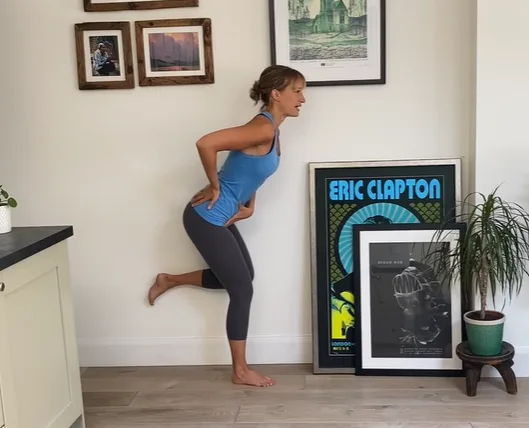
The McConnell squat is a great Pilates squat exercise if you are a runner and looking to get stronger, if you struggle with balance and want to improve it or if you have back pain and have been told you need to strengthen your glutes.
A Pilates squat exercise is a compound movement which means that it works the whole of your body. However, squatting on one leg like the McConnell squat is way more functional. We spend most of our time on one leg so if you want to improve your balance, or be faster and stronger when you run, one leg exercises are the key.
In this article, we’ll be discussing:
- What is a McConell squat
- How to do the McConell squat
- What are the benefits of McConell squat
- Who is the McConell squat suitable for / not suitable for?
What Is the McConnell Squat Pilates Exercise?
Essentially the McConnell squat is one of many Pilates squat variations. As mentioned above it’s performed on one leg and a wall is used as a support - this is a great way of getting strong while you improve your balance.
It’s an excellent exercise to do before you go for a run, work out in the gym, or simply go for a long walk.
How To Do The McConnell Squat
- Using a wall, lift your knee up the wall so that your leg is at a right angle,
- Push your knee into the wall
- Gently lower yourself into a pretend-seating position, ensuring your left leg doesn’t go over your foot and keep your back straight
- Hold for ten seconds.
- Swap and do the other leg.
- Repeat.
McConnell Squat Exercise Tips
- Keep your shin vertical
It is really tempting for the first movement to bend your knee and feel it go over your toes. Try instead to break at the hips, like you are trying to push someone over with your bottom. This will move the thigh bone rather than the shin and immediately load your glute more! Remember your pelvic clock if you are unsure. - Push harder and stay straight
If you want more of a challenge, simply push into the wall harder. This will tempt you to lean away from the wall. Instead, try to keep yourself in a straight line over your standing leg. This way you load the stability muscles around your hip much more! - Use support
If you are trying to get stronger to help with your balance, use the support of a wall or countertop. Once you have perfected the movement and built some strength, then challenge yourself not to hold on. - Try to release
Remember that you have to spread your sit bones as you go down. Every muscle needs to work through its full range, and this includes the pelvic floor! - Use a mirror
If possible, perform this exercise in front of a mirror in order to maintain good form. Over time, you will be able to leave the mirror behind.
McConnell Squat Benefits
A McConell squat, or any type of Pilates squat for that matter, is an effective way to tone the legs and glutes, strengthen the core muscles and increase flexibility.
Although it may seem like a basic exercise, it isn't easy to do. It works the entire body and aside from the wall, no equipment is necessary.
Incorporating squats into your exercise routine helps to strengthen the quadriceps, hamstrings, and glutes. It's also brilliant for the core as it demands so much in terms of posture and support.
Who Is The McConnell Squat Exercise Suitable For?
The McConnell Pilates squat exercise is an ideal exercise for athletes of all sports and skill levels, but it's especially useful for runners. The single-leg squat works the same muscles used for running: the hips, hamstrings, quadriceps, gluteus maximus, and calves.
It’s also great for walkers or anyone looking to improve their balance and stability.
Who Is The McConnell Squat Not Suitable For?
If you have had an ankle, knee, leg, hip, or back injury then it might be best to speak to a medical professional or your Clinical Pilates Instructor to see if this exercise is right for you or if you need to make adjustments. You will feel your muscles and core working during this exercise, but if it’s painful then do stop.
Why Do The McConnell Squat Exercise?
Adding single-leg Pilates squats to your training program helps to develop strength, balance, and coordination, and reduce the pain of runner's knee.
This exercise will also develop stability and core strength, as well as prevent injury and improve performance.
If you are new to fitness or worried about starting a new exercise such as the McConnell squat, we would advise you to always speak to your doctor or physio, or clinical Pilates instructor here at Complete Pilates who are all trained to safely treat and create manageable plans to keep you healthy.
Related Reading: Pilates exercises for legs
Key Takeaways
- The McConnell squat is a single-leg Pilates squat variation that helps build strength, balance and control.
- It is especially useful for runners, as it targets key running muscles including the glutes, hamstrings, quadriceps, calves and hip stabilisers.
- Using the wall provides support and feedback, making it easier to improve alignment while still challenging single-leg stability.
- Good technique is essential, especially keeping the shin vertical, sitting back through the hips and staying aligned over the standing leg.
- The McConnell squat can support injury prevention and performance, but should be modified if you have ankle, knee, hip or back pain.
Join the newsletter
Good news stories, exercise tips and short classes. One email a month.
Conclusion
The McConnell squat is a simple but highly effective Pilates squat variation for improving single-leg strength, balance and coordination. Because it works the hips, glutes, thighs, calves and trunk together, it is particularly useful for runners, walkers and anyone wanting to improve lower limb control.
Although it may look straightforward, the McConnell squat is a challenging functional exercise. The key is to move with control, keep good alignment and use support where needed. If performed well, it can help build strength, improve stability and support more efficient movement during running, walking and everyday activity.
Feeling inspired
If you want to experience the Complete difference and discover the benefits of one-to-one or small group Pilates, book a session at one of our London or Norfolk studios today. Not able to make it to one of our studios? We've got online options to suit you anywhere, anytime.
Our physiotherapist-led Chelsea Pilates studio, our Angel Pilates studio, our Pilates studio in London City, and our Norfolk Pilates studio in East Anglia, offer a highly tailored approach to your Pilates training. Whether your goal is to manage a health condition, rehabilitate from an injury or to improve your strength and fitness, Complete Pilates is the studio for you.
Education is key
These blogs are designed to give information to everyone, however, it is important to remember that everyone is different! If you have not seen one of our therapists and have any questions about injuries, what you have read or whether this may be useful to you, please just ask. We are more than happy to help anyone and point you in the right direction. Our biggest belief is that education is key. The more you understand about your injury, illness and movement, the more you are likely to improve.
If you are not sure whether this is for you, simply get in touch. We are here to help!
FAQs
What is the McConnell squat?
The McConnell squat is a single-leg squat variation performed with one knee pressing into a wall for support. It is used to improve strength, balance, hip stability and lower limb control. It is an easy exercise to do at home as you require no props except the wall!
Why is the McConnell squat good for runners?
The McConnell squat is useful for runners because it strengthens many of the muscles used in running, including the glutes, hamstrings, quadriceps, calves and hip stabilisers. It also helps improve single-leg balance and control. It is a great warm up exercise to get everything firing before you run.
What muscles does the McConnell squat work?
The McConnell squat works the glutes, quadriceps, hamstrings, calves and trunk muscles. It challenges the stabilising muscles around the hip and pelvis. Most importantly it does this in a standing position which is a much more functional position for us!
How do I know if I am doing the McConnell squat correctly?
You should feel the standing leg working, especially around the glute and hip. Try to keep your shin fairly vertical, sit your hips back and avoid leaning away from the wall. Using a mirror can help you check your alignment. You leg should stay stable on the wall rather than sliding down and the more you press into the wall, the more you should feel it in your standing leg.
Who should avoid the McConnell squat?
You should take care or seek advice before doing the McConnell squat if you have acute ankle, knee, hip, leg or back pain. If the exercise causes pain rather than muscle effort, stop and speak to a physiotherapist or clinical Pilates instructor.
Published 3 Sep 2021 · Updated 8 Jul 2026