Foam Roller Exercises For Back Pain
Do you suffer from back pain? If you spend most of your day sitting at a desk or if you take part in a lot of sports or fitness classes, then there is a high chance that you have experienced some sort of back pain before.
Back pain is one of the most common reasons people go to the doctor or miss work, with almost a third of UK adults experiencing this problem. No matter if your back pain is chronic or short-term, it can interfere with your day-to-day activities, your activity and exercise routine and your sleep.
Fortunately, there are many things you can do to prevent or relieve back pain.
Can A Foam Roller Help With Back Pain?
Foam rollers are a useful tool that can help people experiencing back pain, helping to improve mobility, reduce muscle tension and strengthen stability muscles - therefore positively impacting your symptoms.
Key Takeaways
- Foam rollers can support back pain recovery when used correctly. They can help improve mobility, reduce muscle tension, build core stability and strengthen the muscles that support your spine, making them a useful addition to a back pain exercise programme.
- Movement quality is more important than rolling harder. Combining gentle foam rolling with controlled strengthening and mobility exercises provides greater long-term benefits than simply rolling over tight muscles. Always work within a pain-free range and let your symptoms guide your exercise.
- Not all foam roller exercises are suitable for everyone. Start with beginner-friendly movements that improve posture, thoracic mobility and core control, and avoid advanced balancing exercises or directly rolling over the lower back if you have pain or a recent injury.
Join the newsletter
Good news stories, exercise tips and short classes. One email a month.
What Are The Causes of Back Pain?
Understanding the possible cause of your back pain is important because different types of pain respond differently to exercise.
There are many different causes of back pain, including:
- Muscle or ligament injuries. If you are lifting something heavier than normal or doing a new activity and have a history of back pain, this can cause muscle injuries.
- Disc herniations or prolapses. Discs act as cushions between the bones (vertebrae) of your spine. Genetics is the main reason for our discs degenerating over time, and this can lead to the softer material in the inside of the disc pressing on the outer layer. This can cause nerve irritation and pain.
- Stenosis. Gradually, over time, we get normal wear and tear in our spine. This is a normal sign of ageing and not something we can change! Stenosis means a narrowing and can happen anywhere in your back, but is most common in the lower back.
- Mechanical back pain. This means that you are putting more stress on one part of your body as the other is not working as efficiently. This happens a lot as we tend to stay in relatively sedentary postures during the day. Our body then compensates for less flexibility, reduced strength and stability, by moving differently.
Who Is More At Risk Of Back Pain?
Below are a few other factors that can increase the likelihood of getting back pain:
- Older age and genetics – unfortunately, something we cannot change!
- Osteoporosis – this is more common in post-menopausal women
- A sedentary lifestyle – the government recommends 150-300 minutes of a variety of intensities of exercise per week to maintain our health and fitness.
- Reduced physical strength – this can be from illness, injury or lifestyle
- Heavy manual work or repetitive movements
- Medical conditions such as arthritis or cancer
- Smoking and alcohol
- Obesity
- Reduced sleep
- Stress
(Nieminen, Pyysalo & Kankaanpää, 2021.)
The Benefits Of Foam Roller Exercises For Back Pain
- Eases muscle pain
- Can be used to challenge and strengthen your core stability
- Can be used to strengthen your legs and back
- Helps to relax and stretch
- Can make the exercises more interesting
What Our Experts Say
When used the right way, foam rollers can be a great tool to help manage back pain. They can be used to reduce muscle tension and ease painful symptoms in the short term through self-massage and stretching, but then also be used as a form of exercise equipment to help build core stability and challenge rehab. They're readily available in gyms but are also an easy piece of equipment to store at home.

The Best 4 Foam Roller Exercises For Back Pain
If you’re experiencing back pain, the following 4 foam roller exercises are designed to improve posture, core stability, flexibility and strength and are all created to help with back pain.
If you have had a recent back injury, are new to exercise, have any leg pain or have regular and recurring back spasms, we recommend you get in touch with us, another Physio or your GP to discuss the suitability of these exercises. If any of these movements causes you pain, it is best to stop and consult a healthcare practitioner who can offer you individual advice and a full assessment and diagnosis.
1. Foam Roller Mid Back Exercise
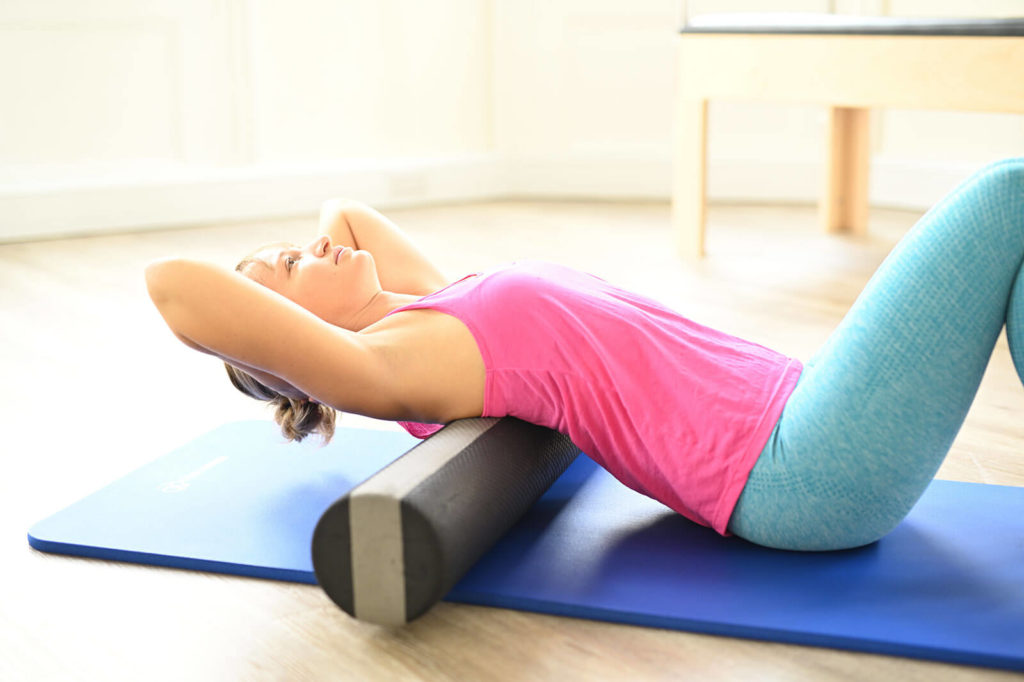
The upper back is an area where most of us store our tension and stress. This stretch can help to relieve that tension and improve your posture. Most of us sit at a desk all day, and often we will be hunched forwards and not really move. This movement will help you to open your mid back so you feel as though you can sit up straighter and breathe easier!
- Sit on the floor and place the roller around your mid shoulder blades.
- Take your hands behind your head and let your elbows be visible in your peripheral vision.
- Try to let the weight of your head be taken by your arms.
- On an exhale, slowly start to move over the roller.
- Try to keep your ribs from simply popping up and your bottom sticking out.
- Pause at the bottom and take a few breaths.
- As you exhale, let your hands retake the weight of your head and turn through your rib cage as if you were doing a chest lift. This will bring you back up.
- Repeat 3-4 times
Top Tips
- Place a pillow under your head to have something to rest on at the bottom of the stretch
- This exercise is great to do a little and often.
2. Foam Roller Core Exercise: Dead Bugs & Femur Arcs

This foam roller exercise is great for helping to improve your core strength and will give you a bit of a challenge, as it is not a stable surface.
- Lie on the foam roller so that the back of your head is at one end and your tailbone is at the other.
- Let your hands rest palm down on the floor and keep your feet narrower so they are in line with your sit bones.
- As you breathe out, bring one leg up so that it is in a table top (90/90) position with the knee above the hip.
- Inhale to take the leg back to the floor and repeat on the other side.
- As you are lifting the leg, imagine you are zipping up internally from your back passage to front passage to tummy button and allow your ribs to move. The three heavy spots in your back should remain the same.
- You can progress this to a femur arc by bringing both legs to table top and taping the foot from here.
Top Tips
- Put a pillow under your head if it feels like you are extending your neck backwards and your chin is pointing up towards the ceiling
- If you are struggling with balance, take your hands a little wider to help support you rather than your legs
- Before you start, feel the heaviness in your head, back of ribs and tailbone. This should remain the same throughout the movement.
- Change the breathing so that you are not just breathing out to lift the leg and in to put it down. This will challenge you more.
- Try to move from the hip – this means that the bend in your knee doesn’t change.
3. Foam Roller Core & Back Exercise: Weighted Arm Arcs
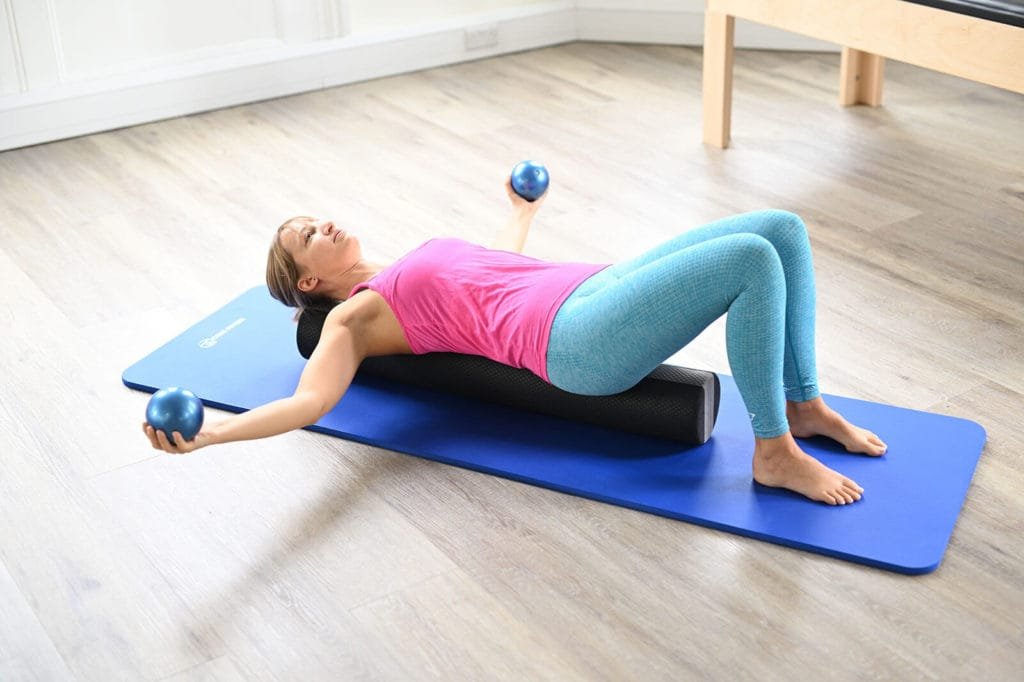
This is a great way of getting your core to work and stabilise your back. It is also great as you do not have to put any strain on your lower back, so you can feel confident in the movement! It will also help to open your chest and improve your posture.
- Lie on your back in the same position as above.
- This time hold onto some light weights, tins, or even be empty-handed!
- Try to keep your feet narrow rather than wide to stabilise you; this will switch on your core system more.
- Bring your hands up towards the ceiling, palms facing each other.
- As you exhale, start to open your arms to move them outwards until your arms are in line with your body.
- Pause to feel the stretch across your chest and then use the exhale again to bring your arms back up to the ceiling.
- Try to keep the arm bend the same throughout the movement.
- Repeat this movement a few times.
- Then try taking the arms overhead, pausing in the stretch and bringing them back up again.
Top Tips
- Keep those 3 heavy spots the same so that you know you are maintaining your spine neutral.
- The most common movement fault is to ‘flare your ribs’. All this means is that you have probably run out of range of movement in your shoulder joint, so your back is extending to allow you to go further! This is a normal response and not one we want to stop! Instead, reduce the range of the movement and stop before your ribs start to lift, rather than forcing them down!
- You should be able to comfortably breathe through the whole movement. If you can’t, you may be bracing! If this is the case, reduce the weight rather than taking your legs further apart and go back to your breath.
4. Foam Roller Back Exercise: Thread The Needle
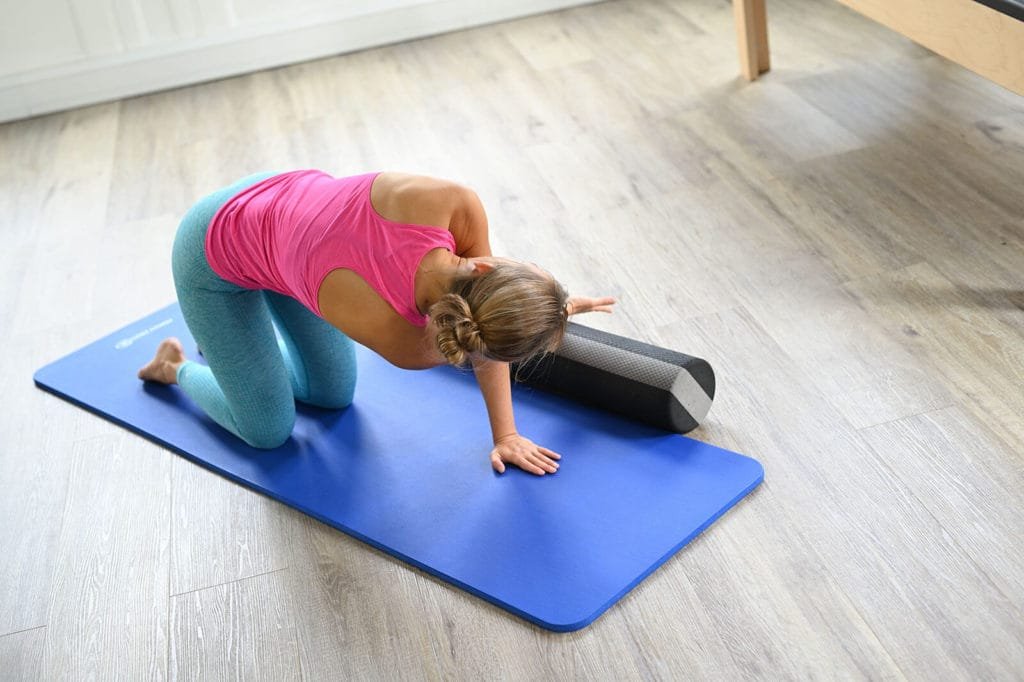
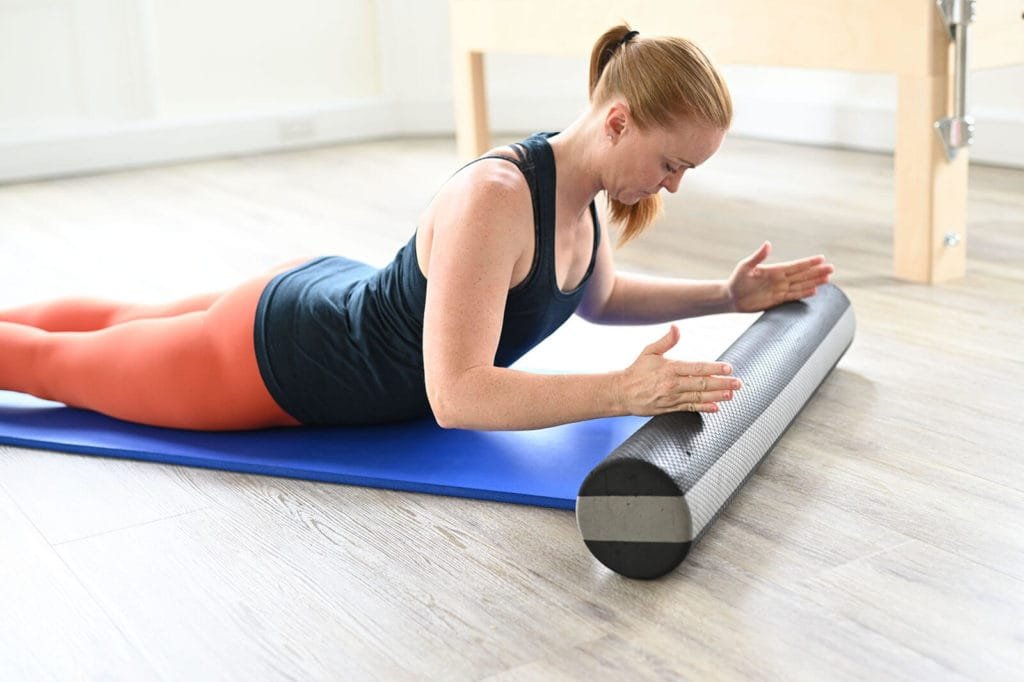
This exercise is a great way of releasing your back. Remember to take it slowly as you have to get back up again!
- Come onto all fours and place the roller to one side. This will be the side you turn to first.
- Do a few cat cows to find your middle ground, then thread the hand which is furthest away from the roller under the other to light rest there.
- As you exhale, roll the roller away from you, keeping your supporting arm straight.
- You will get to a place where you feel a little stuck!
- If you want to increase the movement, bend the supporting arm and allow yourself to go further.
- Pause into the stretch and check that your thighs are both vertical.
- Take a few deep breaths into your rib cage to help release your mid back.
- As you breathe out, press into your supporting arm and pull the roller back towards you.
- Repeat this 4-5x before changing to the other side
Top Tips:
- Take this movement slowly and use your breath to encourage the movement. Your ribs attach into your mid back so if you try to expand these sideways, you will actually get more movement
- Keep the range smaller if you are nervous and avoid bending the arm.
Related reading: Thread the needle exercise benefits
How To Use A Foam Roller For Back Pain Safely
When using a foam roller for back pain, the goal should be gentle movement and improved mobility rather than forcing pressure into painful areas.
Start with:
- Slow movements
- Controlled breathing
- Short sessions
- Comfortable pressure
Avoid spending long periods repeatedly rolling over the same area. While this may temporarily change symptoms, combining foam rolling with strengthening and mobility exercises is usually more effective for long-term progress.
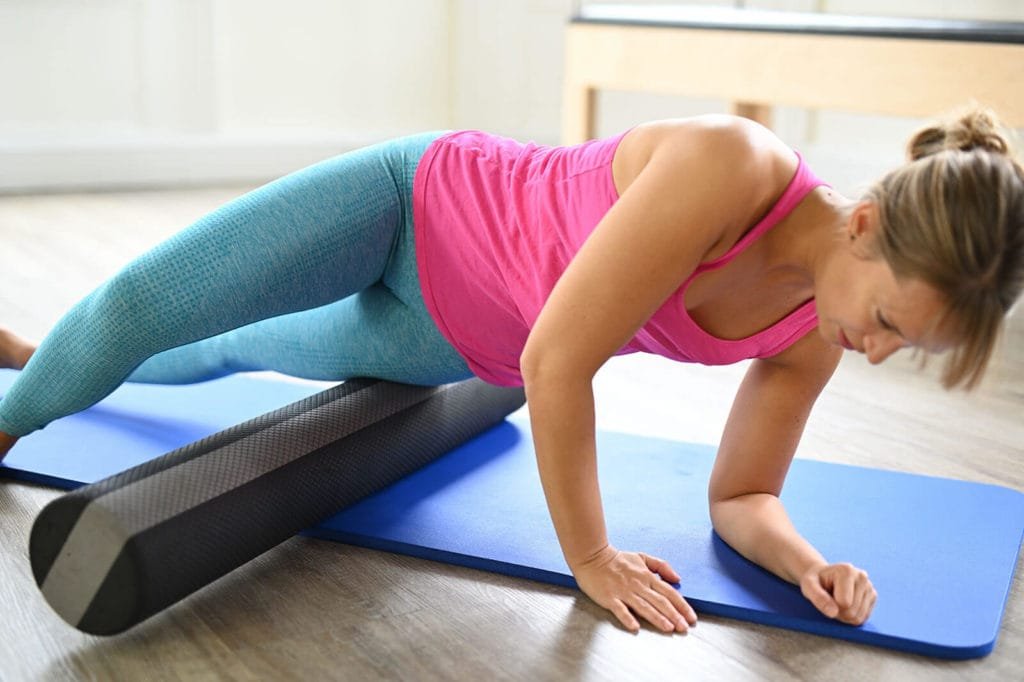
Foam Roller Exercises To Avoid If You Have Back Pain
Doing foam roller for back pain exercises are great for anyone at any level of strength and fitness. You can challenge yourself with it as well as assist your movements with it.
Although exercises with a foam roller may be effective for easing your back pain, it’s important to take care when doing any of these and work within your pain-free range. If you do this, your body will realise that these movements are ok so it will allow the muscles to work and stabilise you. If you try to push through the pain, your body will likely respond by making it more painful, so don’t.
If you do have back pain, avoid:
- High-level exercises such as bridging with your feet on the roller, full swan with arm roller pulls, or a full dead bug where your arms and legs are off the floor, and you are balancing on the roller
- Simply rolling out the muscles - this will give you some symptomatic relief, but you need to make sure you then do some strength or stability exercises afterwards to make sure your body is happy staying in this new range! Remember, muscle tightness can be due to weakness and can be there to prevent you from going into excessive ranges of movement to protect you.
The best advice we can give you if you have back pain is that your exercise should make you feel better, not worse! If it does, please get in touch or ask a physio or your GP for help.
FAQs
Can a foam roller help with back pain?
Yes, a foam roller can help some people with back pain by improving mobility, reducing muscle tension and supporting stability exercises. It is most effective when used alongside strengthening and controlled movement rather than just rolling tight muscles. You may want to ensure you are using the right type of roller for each area as more surface areas likely don't want the lumpy rollers.
Can I use a foam roller on my lower back?
Yes you can roll on your lower back but you want to make sure that you are on the muscles on the side rather than directly onto the spine. You may also want to use a flat roller and ensure you have a lot of the weight in your legs so that you are not directly rolling on your spine.
What are the best foam roller exercises for back pain?
Helpful foam roller exercises for back pain include mid-back extension, dead bugs, femur arcs, weighted arm arcs and thread the needle. These exercises can support posture, trunk control, flexibility and thoracic mobility. It is important to check with your physiotherapist or Clinical Pilates instructor if these exercises are appropriate for you as depending on the reason for your back pain they may not help.
How often should I foam roll for back pain?
Short sessions of around 5–10 minutes a few times per week can be a good starting point. You can also use a foam roller before exercise to prepare your body for movement or afterwards to support mobility and relaxation.
Can foam rolling make back pain worse?
Yes, foam rolling can make back pain worse if it is too aggressive, targets the wrong area or pushes into pain. Stop if you feel sharp pain, worsening symptoms, tingling, numbness or pain travelling down your leg, and seek professional advice if symptoms persist.
Start Using A Foam Roller To Ease Your Back Pain
Exercises with a foam roller are great for anyone who suffers from back pain as it can help to improve your movement and mobility, as well as how stable you feel around your spine. You can also use it to roll out muscle tension in the front of your thighs, side of your legs, back of your legs and glutes. This may give you some symptomatic relief, but remember to try some of the stability exercises above afterwards.
If you suffer from general back pain, it can be a great tool to help mobilise your back and change up your exercise programme to add more stability.
At Complete Pilates, we offer 1:1 programmes to help you reach specific goals. So whether you are recovering from a back injury or you are looking to improve the mobility and range of motion in your back, we can provide you with a Pilates plan to help. We also have an on-demand service, which has foam roller- specific classes and more being added weekly.
If you are worried about starting a new exercise style, exercisinge in general after an injury, or using something such as a foam roller, we are always happy to chat and answer any questions, as well as direct you to the best place. Alternatively, learn more about Physio Pilates.
Get in touch, call us on 02037645668 or book today for further information and advice.
Resources
Nieminen, Pyysalo & Kankaanpää (2021). Prognostic factors for pain chronicity in low back pain: a systematic review. Pain Reports.
Education is Key
These blogs are designed to give information to everyone, however, it is important to remember that everyone is different! If you have not seen one of our therapists and have any questions about injuries, what you have read or whether this may be useful to you, please just ask. We are more than happy to help anyone and point you in the right direction. Our biggest belief is that education is key. The more you understand about your injury, illness and movement, the more you are likely to improve.
If you are not sure whether this is for you, simply get in touch. We are here to help!
Related Blogs
- Pilates for upper back pain? 9 Effective Stretches for Upper Back Pain
- Pilates for back pain: 8 effective Pilates back exercises to strengthen your back
- How to avoid back pain with the swan exercise
- Pilates for Lower Back Pain
- FAQs for back injuries
Published 24 Nov 2021 · Updated 11 Aug 2026