
Book Openings – Your Step by Step Guide with Video!
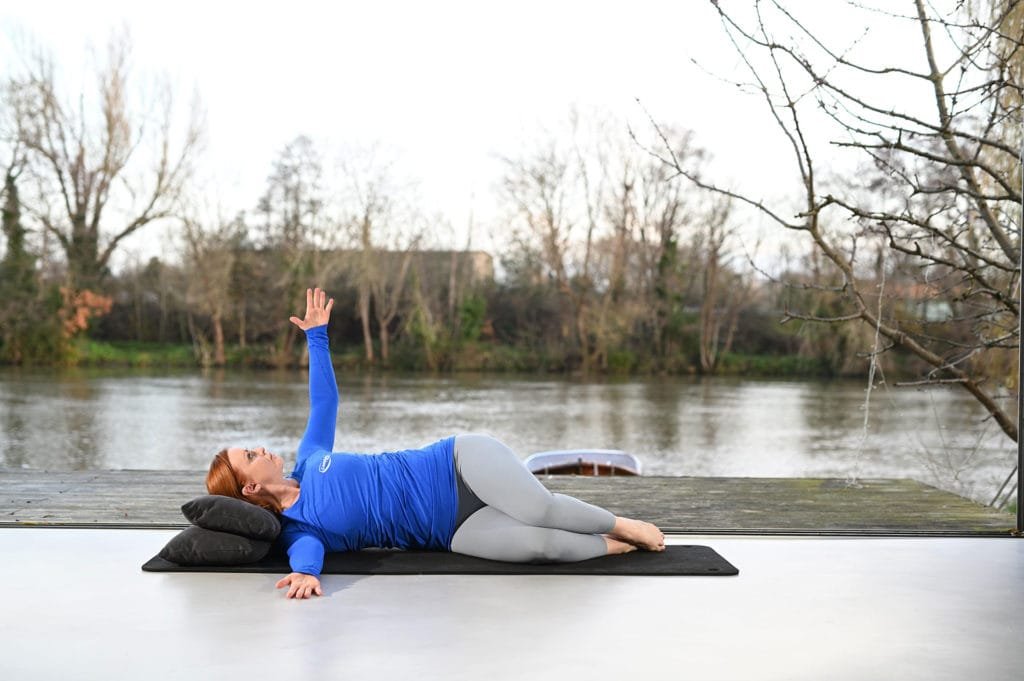
If you spend a lot of time at your desk and want better posture or you always complain that your back is sore and stiff then the open book stretch, also known as book openings, is the movement for you!
Book openings are great for improving mobility through the spine, particularly through the thoracic region. They are also a wonderful stretch for the chest and provide great shoulder mobility.
In this article, we’ll be discussing:
- What are book openings?
- How to do book openings?
- What are the benefits of book endings?
- Who are book openings suitable for / not suitable for?
What Are Book Openings? Or What Is The Open Book Stretch?
Book openers or open book stretches are great if your back is sore and stiff. They are great for beginners and are so easy to do at home with just a mat. They are also ideal if you spend the majority of your day at a desk or on hunching over a phone.
They provide release and stretch for chest muscles as well as movement and mobilisation for your arms, shoulder, head and neck.
Purposes of book openings:
- mobilise your thoracic spine
- challenges your pelvic stability
- encourages deeper breathing by opening the chest
- Great for any digestive issues you might have
How To Do Book Openings?
Your spine loves to twist, so you will feel instant results! The best part is you can do this anywhere, including in bed so it can be a great starter to your day.
- Start by lying on your side with your feet in line with the back of your pelvis. If you don’t like lying on your side. there should always be pillows under your head to support your neck.
- Inhale, feeling the breath come down to your lower rib cage and tummy, keeping the shoulders relaxed.
- Lift the top arm up and over behind your back. Follow your hand with your eyes. Concentrate on keeping the pelvis and lower legs still and facing forwards.
- As you rotate around, sigh out to allow your body to rest
- You can pause in the rotation to take a few breaths. This will encourage your mid back (thoracic) rotation as well as rib mobility.
- Breathe out as you bring the arm back around to the start position.
- Repeat
Book Opening Exercise Tips
- Keep your hand on the floor
Trying to keep your hand on the floor during the progression is a great way to help improve your shoulder range. Take this slowly and allow your shoulder blade to move to help your mobility. - Allow your pelvis to move
Having someone hold you still will not help. Instead it will only make you twist from the most mobile segment in your spine. Instead, try reaching the top thigh along the bottom though. This will pick up the slack in the system and give you more of a stretch. The best part is that you control this meaning you are not forced to move somewhere you are not ready to! - Use your breath
Once you are in your stretch, try using lateral breathing techniques. This will help you to gain some of the accessory movements around your mid back and ribs, giving you more mobility. It will also give your muscles a chance to settle, meaning you can go a little further. - Take your time
The more gentle you are with yourself, and the more time you give your body to settle, the more likely you are to gain more movement. - Try strength afterwards
Opening up a new range of movement is great. However, remember that you need strength to stay there. Try some other exercises such as bridging, sumo squats exercise video page or knee hovers to help you stay in this new range
A well-performed book opening is far more than a simple stretch. It restores movement through the thoracic spine, encourages rib cage mobility and opens the chest, all of which can help counteract the effects of prolonged sitting and improve the way your body moves during everyday activities and sport. The key is to focus on smooth, controlled rotation rather than forcing your range of movement—quality of movement will always provide greater long-term benefits than simply trying to twist further - Helen Vasser, Clinical Pilates Instructor
Book Openings Benefits
Book openings are great for:
- improving mobility through the spine, particularly through the thoracic region.
- stretching the chest
- improving shoulder mobility
- encouraging deep breathing
- improving digestion
Who Are Book Openings Suitable For?
Book openings are suitable for anyone who has any discomfort in their back, anyone who plays lots of sports or anyone who feels they need a restorative stretch around their upper back and shoulders.
Who Are Book Openings Not Suitable For?
Book opener exercises may not be suitable for you if you find they aggravate your back pain. Do avoid or seek advice from your GP or a physiotherapist to see if this exercise is right for you. If it just isn’t working, then consult with an exercise specialist such as a Clinical Pilates Instructor for your own individual advice.
Get in touch online or contact us on 0203 764 5668 for further information and advice!
Why Do Book Openings?
Why not! As this article highlights, there are so many benefits to book openings.
If you are new to exercise at Complete Pilates, we would advise you to always speak to your doctor or physiotherapist before starting a new exercise routine, especially if you have any health concerns or are new to fitness.
If you would like more information, then do reach out to our team of clinical Pilates instructors here at Complete Pilates who are all trained to safely treat and create manageable plans to keep you healthy.
What Our Experts Say

Book openings are one of my favourite exercises because they teach the body to rotate efficiently rather than simply stretching into more range. By combining controlled movement with relaxed breathing, this exercise helps improve body awareness and encourages better movement patterns that can carry over into everyday activities, work and sport.
Helen Vasser - Clinical Pilates Instructor
Conclusion
Book openings are a simple yet effective way to explore spinal mobility and reconnect with the movement of the upper body. By combining gentle rotation with mindful breathing, this exercise can help reduce feelings of stiffness and encourage more comfortable, efficient movement. Whether included within a Pilates session or used as a movement break during the day, book openings are a valuable reminder that quality of movement matters.
Key Takeaways
- The exercise encourages movement from the thoracic spine while maintaining control through the pelvis and core, helping to develop efficient movement patterns.
- Book openings can be adapted for different abilities, including seated variations, making them accessible for people experiencing stiffness from daily activities or prolonged sitting.
- Like many Pilates exercises, the focus is not on how far you move, but on moving with control, precision and awareness.
Join the newsletter
Good news stories, exercise tips and short classes. One email a month.
Feeling Inspired
If you want to experience the Complete difference and discover the benefits of one-to-one or small group Pilates, book a session at one of our London or Norfolk studios today. Not able to make it to one of our studios? We've got online options to suit you anywhere, anytime.
Our physiotherapist-led Pilates studio in Chelsea, our Angel Pilates studio, our Pilates studio in City, and our Norfolk Pilates studio in East Anglia, offer a highly tailored approach to your Pilates training. Whether your goal is to manage a health condition, rehabilitate from an injury or to improve your strength and fitness, Complete Pilates is the studio for you.
Education is Key
These blogs are designed to give information to everyone, however, it is important to remember that everyone is different! If you have not seen one of our therapists and have any questions about injuries, what you have read or whether this may be useful to you, please just ask. We are more than happy to help anyone and point you in the right direction. Our biggest belief is that education is key. The more you understand about your injury, illness and movement, the more you are likely to improve.
If you are not sure whether this is for you, simply get in touch. We are here to help!
FAQs
1. What muscles do Book Openings work?
Book openings primarily target the muscles responsible for thoracic spine rotation, including the internal and external obliques, which help rotate and stabilise the trunk, and the multifidus, which supports segmental control of the spine. The movement also encourages mobility through the thoracic extensors, intercostal muscles between the ribs, and the serratus anterior, which assists with shoulder blade movement. By maintaining control through the pelvis and core, book openings also encourage coordinated activity of the deeper abdominal muscles, helping to improve spinal mobility and movement efficiency.
2. How often should I do Book Openings?
They can be practised regularly, even daily if comfortable. A few controlled repetitions on each side can be enough to encourage mobility and ease.
3. Why is breathing important during Book Openings?
Breathing plays an important role in book openings because it helps create movement through the ribcage and upper spine. As you inhale, the diaphragm contracts and lowers, allowing the ribs to expand in multiple directions and encouraging mobility through the thoracic spine and costovertebral joints (where the ribs connect to the spine). This can help improve rib movement and reduce unnecessary tension in the muscles around the neck, shoulders and upper back.
The exhale supports gentle activation of the deep abdominal muscles, including the transversus abdominis and obliques, helping to maintain control through the pelvis and spine as the body rotates. Coordinating breath with movement encourages better connection between the respiratory system and the muscles that support posture and spinal stability, allowing the exercise to be performed with greater ease and control.
4. I have a shoulder injury, can I still do Book Openings?
It depends on the type and stage of your shoulder injury. Book openings involve movement through the shoulder, ribcage and upper spine, so the exercise may need to be modified to avoid aggravating symptoms. Keeping the movement smaller, supporting the arm, or focusing more on spinal rotation rather than the range of the arm can make it more comfortable.
If you experience pain, catching or increased symptoms, it is best to stop and seek advice from a qualified healthcare professional. A Pilates instructor or physiotherapist can help adapt the exercise to your individual needs and guide you towards safe, progressive movement.
5. Can I do Book Openings if I have Osteoporosis?
Yes, book openings can be an excellent exercise for people with Osteoporosis when performed correctly. They are particularly helpful for improving thoracic spine mobility, encouraging an open chest and supporting an upright posture, all of which become increasingly important as we age. The key is to perform the movement with good technique, rotating through a long spine rather than twisting from a rounded position, and avoiding any forceful or jerky movements. As with any exercise programme, if you have osteoporosis or low bone density, we recommend seeking advice from a healthcare professional or qualified Pilates instructor to ensure the exercise is appropriate for you and adapted to your individual needs.
Published 1 Oct 2021 · Updated 28 Jul 2026