How To Do The Pilates Pelvic Clock
Do you get back pain and want an easy exercise to help? Do you wonder why you get lower back pain after being in the gym? Do you feel really stiff but never feel like you can get a good enough stretch or your mobility just is not improving? Maybe you have plateaued in your Pilates training and are not sure why?
In this article, we’ll be discussing:
- What is the pelvic clock
- How to do the pelvic clock exercise
- What are the benefits of the pelvic clock exercise
- Who is the pelvic clock exercise suitable for / not suitable for?
What Is The Pelvic Clock Pilates Exercise
Understanding the pelvic clock exercise is the basis for all movements we do!
Being able to do a pelvic tilt well, will improve your squat and deadlift, increase your stretch and help you to understand even the more complicated movements.
It’s also suitable for pretty much everyone.
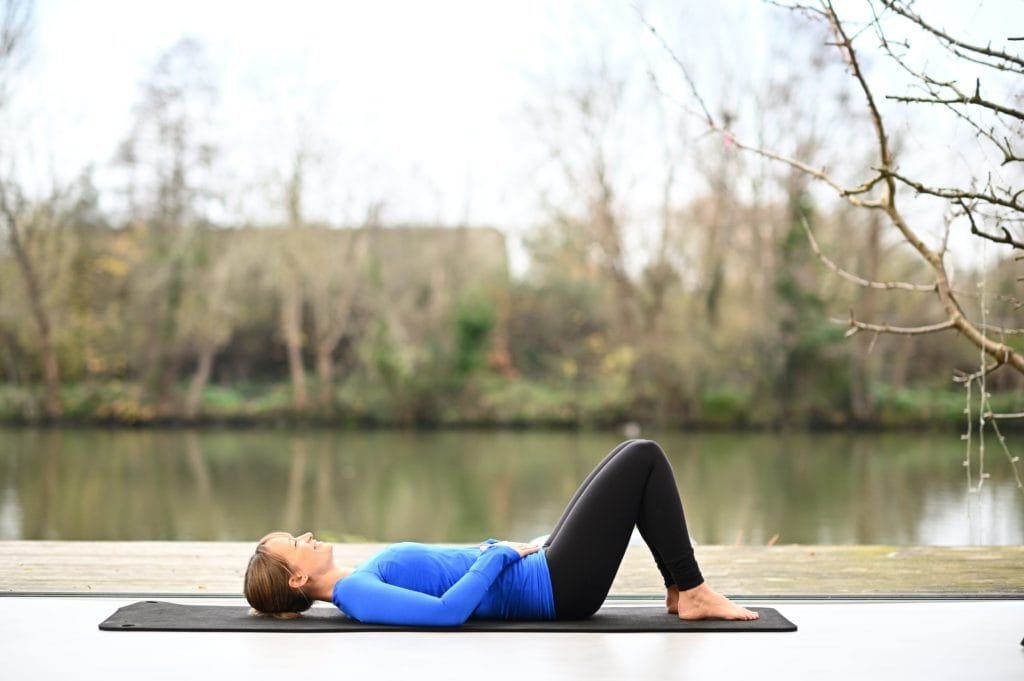
The pelvic clock is a small and subtle Pilates exercise which is carried out on a mat where you engage your abdominal and pelvic floor muscles. Firstly, picture there is a clock lying flat at the lower part of your abdomen. Twelve o'clock is at your belly button, six o'clock is at the top of your pubic bone. Your hip bones are at nine and three. Next engage your abdominal muscles to move the pelvis only an inch or so in each direction using the abs and not the back.
This exercise should be used to build awareness of positioning your abs, pelvis, and spine.
How To Do The Pelvic Clock Exercise
- Lie on your back with your knees bent and feet flat on the floor and in parallel
- Make sure you are in a neutral spine position.
- Relax your neck and shoulders, bringing your shoulders away from the ears
- Bring your hands together so that the fingertips of your index fingers are touching and your thumbs touch.
- Place them at the bottom of your lower belly so that the tips of your fingers rest lightly on the top of your pubic bone, and your thumbs are near your belly button. This allows you to feel the movement of the pelvis.
- Breathe deeply, expanding your ribs evenly and into the lower abs.
- Engage your abdominals and bring your belly down to your spine, lengthening the spine along the floor. This will create a pelvic tilt where your clock is now no longer flat, but down at the 12 o'clock position (navel) and up at the 6 o'clock position (pubic bone).
- Use your abs to rotate your clock down to the side so that the 3 o'clock hip is lower. Continue on the inhale to move around the clock—tilting the pelvis until the six o'clock position is lowest. This will create a small arch in your low back.
- Bring the movement around so that the nine o’clock hip is down. Continue your exhale as you bring your navel (the 12 o'clock position) to the low point again
- Repeat another cycle in the opposite direction
- Repeat each direction two or three times and then reverse
Pelvic Clock Exercise - Top tips
- Finding your ‘neutral’ spine
If you want to find your neutral spine, you need to master this. This will help you get stronger and stop imprinting your spine! - Relax your bottom!
You can start the movement by relaxing your glutes and simply letting your tailbone fall. This way you release the whole of your pelvic floor and will not start the movement in your back. - It's ok to let your head move!
Remember, your pelvis is attached to your spine, which is attached to your head! If you want to create full movement allow this to flow throughout rather than stopping it half way. This will help you to see the timing of your movements. - Focus on your feet
Feeling the pressure in your feet when you do this simple movement will help you to understand where some of the bigger movements come from. Full body integration starts at the beginning!
This movement can be a great way of getting you back into simple exercises after giving birth and can also aid your digestion!
Pelvic Clock Exercise Benefits
The pelvic clock is a brilliant exercise to help achieve flexibility and strength in the lower back, pelvic floor, and core—in order to prevent pain and injury.
Further benefits to the pelvic clock exercise:
- improved circulation to the pelvic organs
- decreased tightness and stiffness especially if you sit at a desk all day
- increased pelvic flexibility (always a good thing);
- improved balance to give greater spinal stability.
Who Is The Pelvic Clock Exercise Suitable For?
This is a perfect exercise if you sit a lot throughout the day, cycle, play golf or if you are pregnant. It can also help those with pregnancy back pain (pre and post natal), digestive issues and other ailments as mentioned above.
Who Is The Pelvic Clock Pilates Exercise Not Suitable For?
This exercise may not be suitable to anyone who has difficulty lying flat. Although it is good for early pregnancy, it may not be comfortable laying on your back in later pregnancy.
We would advise you to speak to your GP or an exercise specialist such as a Clinical Pilates Instructor for your own individual advice and any modifications which may need to be made.
Why Do The Pelvic Clock Exercise?
The pelvic clock Pilates exercise can help with a wide variety of physical problems that could be caused by running, cycling, golf, cycling or general strength training including uneven hip movement, muscle imbalance at the pelvis, tight hip flexors, back pain and hip pain to name just a few. It can also support those who live a sedentary lifestyle or those who may be pregnant or just had a baby - by waking up the core and strengthening the abdominal muscles and increasing flexibility.
If you are new to fitness or worried about starting a new exercise such as the pelvic clock exercise again, speak to your doctor or physio, or clinical Pilates instructor here at Complete Pilates who can create manageable plans tailored to your needs.
Key Takeaways
- The pelvic clock is a foundational Pilates exercise that helps you understand the relationship between your pelvis, spine and abdominals.
- It improves pelvic awareness and control, which can support bigger movements such as squats, deadlifts, bridges and more advanced Pilates exercises.
- The exercise can help reduce stiffness and improve mobility, especially around the lower back, pelvis and hips.
- It is suitable for most people, including desk workers, cyclists, golfers and pre or postnatal clients, with appropriate modifications.
- Small movements matter, as the aim is not to force range but to improve control, timing and awareness.
Join the newsletter
Good news stories, exercise tips and short classes. One email a month.
Conclusion
The pelvic clock is a simple but powerful Pilates exercise that helps you build awareness of your pelvis, spine and abdominal control. Although the movement is small, it can have a big impact on how you move in everyday life, sport and exercise.
By learning how to gently tilt and rotate the pelvis, you can improve spinal mobility, release unnecessary tension and better understand your neutral spine. This can help with lower back stiffness, movement control and progression into more challenging Pilates or gym exercises.
Because it is gentle and accessible, the pelvic clock is a great starting point for many people. However, if lying on your back is uncomfortable, you are in later pregnancy or you have pain, it is best to seek individual advice from a physiotherapist or clinical Pilates instructor.
Feeling inspired
If you want to experience the Complete difference and discover the benefits of one-to-one or small group Pilates, book a session at one of our London or Norfolk studios today. Not able to make it to one of our studios? We've got online options to suit you anywhere, anytime.
Our physiotherapist-led Pilates studio in West London, our North London Pilates studio, our Pilates studio in London City, and our Norfolk Pilates studio in East Anglia, offer a highly tailored approach to your Pilates training. Whether your goal is to manage a health condition, rehabilitate from an injury or to improve your strength and fitness, Complete Pilates is the studio for you.
Education is key
These blogs are designed to give information to everyone, however, it is important to remember that everyone is different! If you have not seen one of our therapists and have any questions about injuries, what you have read or whether this may be useful to you, please just ask. We are more than happy to help anyone and point you in the right direction. Our biggest belief is that education is key. The more you understand about your injury, illness and movement, the more you are likely to improve.
If you are not sure whether this is for you, simply get in touch. We are here to help!
FAQs
What is the Pilates pelvic clock exercise?
The pelvic clock is a gentle Pilates exercise performed lying on your back. You imagine a clock on your pelvis and use small, controlled movements to tilt and rotate the pelvis in different directions. It is often used as a starting exercise in Pilates to bring awareness back into your body.
What is the pelvic clock good for?
The pelvic clock helps improve pelvic awareness, lower back mobility, abdominal control and spinal stability. It can also help you understand neutral spine and improve movement quality in other exercises. It is a pre Pilates exercise as understanding this relationship, and timing, will help you to move more efficiently as you start creating bigger shapes.
Can pelvic clock help with lower back pain?
It may help some people with lower back pain by reducing stiffness, improving pelvic control and encouraging gentle movement. However, if you have ongoing or severe pain, it is best to seek advice from a physiotherapist or clinical Pilates instructor before simply embarking on this movement. There are lots of modifications you can do to this exercise which should mean you can do it without pain.
Is the pelvic clock suitable during pregnancy?
Pelvic clock can be suitable in early pregnancy and may help with pelvic and lower back awareness. As you move through your second and third trimester it is recommended that you do this on an incline so as to reduce the downwards weight on the babies vena cava.
Why is pelvic control important in Pilates?
Pelvic control is important because the pelvis links the spine and lower body. From the spine then comes the head and upper body! Better control and awareness of the movement here can improve posture, spinal stability, hip movement and your technique in exercises both within the studio and outside.
Published 29 Sep 2021 · Updated 9 Jul 2026