Pilates Vs Yoga
Yoga Vs Pilates: What’s The Difference And Which Is Better for You?
The benefits of yoga and Pilates are well known, and the two methods share some noticeable similarities. Both are famous for their ability to calm the mind, improve body awareness and help stretch and strengthen the body.
At Complete Pilates, we don’t like to think of it as simply “Pilates vs yoga”. Instead, we believe these two practices can work brilliantly together.
However, there are some important differences between them. Understanding these differences can help you decide which one is best suited to your goals, whether that is relaxation, strength, flexibility, injury recovery, weight loss, pregnancy, running performance or back pain management.
Is Pilates The Same As Yoga?
No, Pilates and yoga are not the same.
Yoga is an ancient practice with a strong spiritual and philosophical foundation. Many yoga classes include meditation, breathwork, chanting or relaxation, depending on the style and teacher.
Pilates is a more modern movement method created by Joseph Pilates. It was designed to improve strength, posture, control, alignment and movement efficiency. Pilates also has a mindful quality, as it requires focus, concentration and breath control, but it is not usually spiritual in the same way yoga can be.
Both practices connect the mind and body, but they do this in different ways.
Yoga often uses stillness, breath, poses and flow to create awareness and relaxation. Pilates uses precise, controlled movement to improve strength, mobility and body organisation.
Yoga Or Pilates: Which Is Best For Relaxation?
For many people, yoga is the more obvious choice for relaxation.
Yoga often has a clear focus on calming the mind. Breathing techniques, slower movement, meditation and final relaxation can all help reduce stress and create a sense of calm. Some styles, such as restorative yoga or yin yoga, are particularly focused on relaxation and stillness.
However, Pilates can also be relaxing.
Pilates encourages you to breathe deeply, move with control and focus on what is happening inside your body. This can help reduce stress and bring your attention into the present moment.
Because Pilates requires concentration, it can be a great option for people who struggle to sit still during meditation. You are still practising mindfulness, but through movement.
So, if your main goal is deep relaxation, yoga may be your first choice. If you want relaxation alongside strength, posture and movement control, Pilates can be a great option.

Yoga Or Pilates: Which Is Best For Strength And Toning?
Pilates is generally more targeted towards strength and toning.
Pilates exercises are designed to improve how the body functions. They focus on control, alignment, posture, deep abdominal strength, hip stability, spinal mobility and whole-body coordination.
Reformer Pilates and other equipment-based Pilates classes can also add spring resistance, which helps build strength in a controlled and progressive way. This can make Pilates particularly effective for people wanting to tone, strengthen and improve body awareness.
Yoga can also build strength, especially styles that involve holding poses or moving through strong flows, such as vinyasa or power yoga. Holding poses like plank, warrior or chair can challenge the legs, shoulders and trunk.
However, if your main goal is structured strengthening, posture improvement or targeted muscle activation, Pilates may be more specific.
Yoga Or Pilates: Which Is Best For Injury Recovery?
Pilates is often favoured by physiotherapists, osteopaths and rehabilitation professionals because it is easy to adapt to the individual.
At Complete Pilates, we use Pilates to help clients improve strength, mobility, posture, balance and confidence after injury. The Pilates equipment, including the Reformer, Trapeze Table, chair and ladder barrel, allows exercises to be supported, assisted or made more challenging depending on the person.
This makes Pilates particularly useful if you are recovering from injury, managing back pain, returning to sport or trying to build strength safely.
Yoga can still be helpful for some people with pain or injury, especially when it supports relaxation, breathing and gentle mobility. However, certain yoga positions may be too intense or may not be appropriate depending on the condition.
If you are injured, the most important factor is not whether you choose yoga or Pilates, but whether the class is appropriate for your body and taught by someone who can adapt exercises safely.
Yoga Or Pilates: Which Is Best For Flexibility And Mobility?
Yoga is well known for improving flexibility. Many yoga poses involve stretching the hips, hamstrings, shoulders, spine and chest. Over time, regular yoga can help you feel looser and more open.
Pilates can also improve flexibility, but it often does so through controlled movement rather than long static stretches.
Pilates focuses on moving joints and muscles through their available range while maintaining strength and control. This can help improve mobility, which is your ability to actively control movement through range.
In simple terms, yoga may help you stretch further, while Pilates can help you control that range better.
For many people, the best option is a combination of both. Yoga can help improve flexibility and relaxation, while Pilates can help develop strength, control and alignment within that flexibility.

Yoga Or Pilates: Which Is Best For Cardio And Weight Loss?
This depends on the type of class.
A gentle Pilates or yoga class is unlikely to burn as many calories as running, cycling or a high-intensity workout. However, both can support weight loss as part of a wider routine by improving strength, consistency, confidence and body awareness.
More dynamic styles of yoga, such as vinyasa, power yoga or hot yoga, may raise your heart rate more than a slower class.
Similarly, Pilates can be more physically demanding depending on the style. A reformer class, jump board class or more advanced equipment session can be challenging and may feel more intense than mat-based Pilates.
If weight loss is your main goal, the most effective approach usually includes regular movement, strength training, cardiovascular exercise, good nutrition, sleep and consistency.
Pilates and yoga can both be part of that plan, but neither should be seen as a quick fix.
Is Pilates Or Yoga Better For Runners?
Both can be helpful for runners, but in different ways.
Pilates is excellent for runners because it focuses on strength, hip control, pelvic stability, spinal mobility and single-leg balance. These are all important for running efficiency and injury prevention.
Runners often benefit from Pilates exercises that strengthen the glutes, hamstrings, calves, deep abdominals and stabilising muscles around the hips and pelvis.
Yoga can also be helpful for runners, especially for improving flexibility, recovery, breathing and relaxation. It may help reduce stiffness after training and improve awareness of tight areas.
If you are a runner, Pilates may be more useful for strength and control, while yoga may be helpful for recovery and mobility. Combining both can work very well.
Is Pilates Or Yoga Better For Pregnancy?
Both Pilates and yoga can be beneficial during pregnancy when taught by someone appropriately trained.
Pregnancy Pilates often focuses on pelvic stability, posture, breathing, strength, pelvic floor awareness and adapting movement as the body changes. It will also look at your ability to stay strong in your back and arms which will help with carrying your baby ones they are born. It can be particularly useful for managing back or pelvic discomfort and maintaining strength safely.
Pregnancy yoga often focuses on breathing, relaxation, gentle mobility and preparing the body and mind for birth.
The best choice depends on your goals, symptoms and pregnancy stage. In either case, it is important to attend a class or session that is specifically adapted for pregnancy, especially in the second and third trimesters.
Do You Need A Yoga Mat For Pilates?
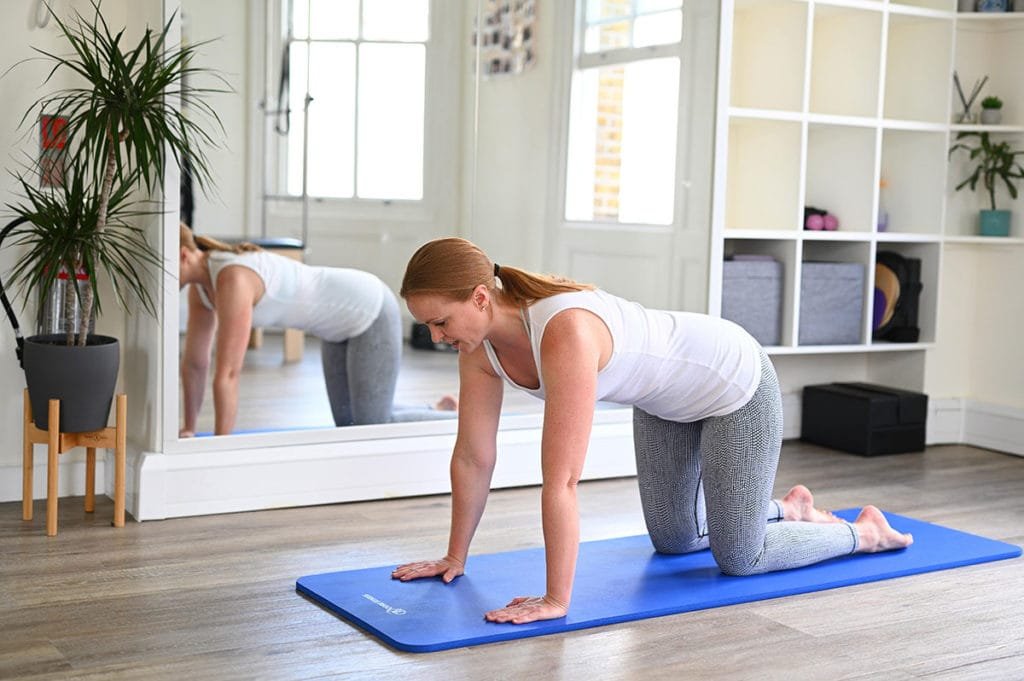
You can use a yoga mat for Pilates, but a Pilates mat is usually thicker.
Yoga mats are often thinner and designed to provide grip for standing poses and balance work. Pilates involves more exercises lying on your back, side, front or kneeling, so extra cushioning can be helpful for the spine, hips, knees and wrists.
If you are doing mat Pilates at home, a thicker mat can make the exercises more comfortable. However, if you are attending an equipment Pilates class, you usually do not need to bring a mat unless the studio asks you to.
Yoga and Pilates socks are often similar. Grip socks can be useful for both, particularly in Pilates studios where they may be required for hygiene and safety.
Can You Do Yoga And Pilates Together?
Yes, absolutely.
Yoga and Pilates complement each other very well. Pilates can help build the strength, control and alignment that may support your yoga practice. Yoga can help improve flexibility, relaxation and breath awareness, which may support your Pilates practice.
You can do both in the same week, and many people can do both on the same day. If you do, it may be helpful to consider the intensity of each session. For example, a strengthening Pilates class and a gentle yoga class can pair well together.
As with all exercise, listen to your body and allow time for recovery.
So, Which Is Better: Yoga Or Pilates?
There is no single answer.
Yoga may be better if your main goals are relaxation, meditation, flexibility and stress relief.
Pilates may be better if your main goals are strength, posture, injury rehabilitation, core control, back support or improving how your body moves.
For many people, the best option is not choosing one over the other, but using both practices in a way that supports their body and lifestyle.
The most important thing is choosing something you enjoy, can do consistently and can adapt to your needs.
At Complete Pilates, we specialise in clinical, physiotherapist-led Pilates. If you are unsure whether Pilates is right for you, or if you are managing pain, injury, pregnancy or a health condition, our team can help you find the right starting point.
Key Takeaways
- Yoga and Pilates are similar but not the same. Both support the mind and body, but yoga has a stronger spiritual and meditative element, while Pilates is more focused on strength, control, posture and movement efficiency.
- Pilates is often more targeted for strength and rehabilitation, especially when using equipment such as the reformer, trapeze table or chair.
- Yoga is often more focused on flexibility, relaxation and stillness, although more dynamic yoga styles can also build strength and fitness.
- Neither is automatically better for everyone. The right choice depends on your goals, body, injuries, fitness level and personal preferences.
- Yoga and Pilates can complement each other well, with Pilates building control and strength, and yoga supporting flexibility, breathing and relaxation.
Join the newsletter
Good news stories, exercise tips and short classes. One email a month.
Conclusion
Yoga and Pilates both offer valuable benefits, but they are not the same thing. Yoga is often more associated with relaxation, meditation and flexibility, while Pilates is generally more focused on strength, alignment, posture and controlled movement.
If you are looking to improve body awareness, build strength, support your back, recover from injury or develop better movement habits, Pilates may be the better fit. If your goals are relaxation, stretching and a more spiritual or meditative practice, yoga may suit you well.
However, you do not necessarily need to choose between them. Many people benefit from combining yoga and Pilates as part of a balanced weekly routine. The best option is the one that meets your needs, feels good for your body and is something you can practise consistently.
Feeling inspired
If you want to experience the Complete difference and discover the benefits of one-to-one or small group Pilates, book a session at one of our London or Norfolk studios today. Not able to make it to one of our studios? We've got online options to suit you anywhere, anytime.
Our physiotherapist-led Chelsea Pilates studio, our Angel Pilates studio, our Pilates studio in London City, and our Norfolk Pilates studio in East Anglia, offer a highly tailored approach to your Pilates training. Whether your goal is to manage a health condition, rehabilitate from an injury or to improve your strength and fitness, Complete Pilates is the studio for you.
Education is key
These blogs are designed to give information to everyone, however, it is important to remember that everyone is different! If you have not seen one of our therapists and have any questions about injuries, what you have read or whether this may be useful to you, please just ask. We are more than happy to help anyone and point you in the right direction. Our biggest belief is that education is key. The more you understand about your injury, illness and movement, the more you are likely to improve.
If you are not sure whether this is for you, simply get in touch. We are here to help!
FAQs
What is the difference between yoga and Pilates?
Yoga and Pilates both use breath, movement and body awareness, but they have different origins and aims. Yoga is an ancient practice with a stronger spiritual, meditative and flexibility focus. Pilates is a modern movement method designed to improve strength, posture, control, alignment and movement efficiency. Pilates can be taught on the mat and with equipment such as reformers whereas yoga tends to be mainly on the mat unless you are doing a hybrid version like aerial yoga.
Is Pilates better than yoga?
Pilates is not universally better than yoga, but it may be better suited to certain goals. Pilates is often a better choice for targeted strengthening, posture, core control, injury rehabilitation and movement retraining. Yoga may be better for relaxation, meditation, flexibility and stress relief. The best choice depends on what you want from your practice. You often find that flexible people gravitate towards yoga whereas those with less mobility head towards Pilates. Often, the reverse would be beneficial.
Is yoga or Pilates better for weight loss?
Neither yoga nor Pilates is usually the fastest route to weight loss on its own. However, both can support weight loss by helping you move more regularly, build strength, improve confidence and reduce stress. More dynamic yoga classes or higher-intensity Pilates sessions may burn more calories, but weight loss also depends on nutrition, overall activity levels including strength based training, sleep and most importantly consistency.
Can you do yoga and Pilates together?
Yes, yoga and Pilates can work very well together. Pilates can help build the strength and control that supports yoga, while yoga can help improve flexibility, breathing and relaxation. You can do both in the same week and, depending on intensity, even on the same day.
Are yoga mats and Pilates mats the same?
They are similar, but not always the same. Yoga mats are usually thinner and designed for grip during standing poses. Pilates mats are often thicker to provide more cushioning for exercises performed lying down, kneeling or side-lying. You can use a yoga mat for Pilates, but a thicker Pilates mat may feel more comfortable.
Published 5 Jan 2022 · Updated 9 Jul 2026