5 Effective Pilates Arm Exercises You Can Do At Home
Arm exercises at home are actually really easy to do and do not require the use of lots of heavy weights and bars.
In this blog we are going to show you 5 at home arm exercises which you can do using a band and your body weight, to help strengthen your arms, particularly your triceps.
Upper body strength is really important in day to day life as it helps with posture, lifting objects, opening heavy doors or simply lifting and playing with your children.
The stronger your arms and back are the easier these become!
All the exercises are suitable for anyone who doesn’t have acute shoulder pain.
If you do have an acute shoulder injury, please check with your treating physiotherapists, or us, before starting these.
All of these at home arm exercises can be made harder by increasing the resistance on the band or adding light weights which you can find around your house, including cans!
Arm Muscle Anatomy
Before getting started on your at home arm exercises, make sure you have an understanding of your arm muscle anatomy. Generally speaking, most people focus on their biceps and triceps when working out. By strengthening the muscles in your arm, you’ll help to maintain a balanced body, reduce the risk of injury, improve your posture, and enhance your workouts.
Biceps
There are a few muscles in the front of your upper arm, the most well known being your biceps.
Your biceps sits at the front of your upper arm between your elbow and shoulder and is responsible for bending (flexing) your elbow and supinating the forearm, or turning your palm up. It has two different heads, a long and short head.
Part of your biceps actually comes from your shoulder blade and then attaches onto the forearm. It works alongside two other muscles in your forearms including coracobrachialis and brachialis.
Biceps is not actually the strongest flexor but works alongside brachialis to support and stabilise it as the forearm flexes. It also is a weak shoulder flexor and one of the heads helps stabilise the shoulder blade when we are carrying weight.
Triceps
In the back of your arm sits your triceps which actually has 3 heads!
The tricep is a large thick muscle which is responsible for straightening (extending) your elbow. Part of the triceps also contributes to shoulder extension (taking the arm backwards) and adduction (bringing your arm from out wide to your body).
The triceps muscles are more active in pushing movements as well as supporting your body weight when your elbows are slightly flexed.
What Our Experts Say
The arms do not work in isolation, especially in everyday tasks like lifting, carrying or pushing. Pilates-style arm exercises are effective because they build strength and control together, helping people improve posture, confidence and functional upper body movement.

Pilates Arm Exercises You Can Do At Home
1. Prone W, T, I
To build arm strength you also need back strength!
This at home arm exercise is a great way of doing both and challenges your range of motion as well.
Start by lying on your stomach, reaching your legs long and pressing your pubic bone into the floor. Hover your nose off the floor to activate your back and neck muscles. Keep this throughout the whole movement, only coming off if you need a rest.
Take your arms, palms down, into a W shape. As you exhale lift your whole arm and forearm off the floor, allowing your shoulder blades to come together.
Lower them back towards the floor but try not to rest them down.
Repeat the movement 10x
Then extend the elbows and take them out to the sides of the rooms with your thumbs up towards the ceiling.
Again, allow your shoulder blades to move and try to keep your arms straight.
Repeat the movement 10x
Finally, take your arms above your head with your thumbs still pointing upwards. Lift the arms up towards the ceiling and lower back towards the floor.
Try to keep your body quiet when you do this rather than lifting up and down.
Repeat 10x before sitting back into the child's pose and resting.
Unless you have acute shoulder pain, this exercise is suitable for anyone. It is a great way of challenging your strength at the end of your range of motion and working your arms.
It also has the added benefit of working all your back muscles which will help to improve your posture!
You can add a light weight if you want to challenge yourself even further.
2. Kneeling Arms Salute
This arm exercise is often seen on the Pilates reformer and can easily be modified to be able to do at home.
This is a great exercise for getting your arms working and shoulder blades moving meaning you will also build some back control.
Using a long band, bring it around your rib cage and hook it under your arms. Hold onto the ends of the band and bring your hands to your forehead, palms facing out.
Come into high kneeling and press your feet into the ground to help stabilise you. Send your pubic bone forwards to centre your pelvic under your ribs.
Remember the shorter the band, the harder the exercise.
Keeping your fingertips together, exhale and press your hands away in a diagonal upwards line.
Pause, and slowly return your hands back to your forehead. Allow your shoulder blade to move as you do this but try to keep your torso quiet.
Repeat this 15-20 times.
Unless you have acute shoulder pain, this arm exercise is suitable for everyone and a great way of building your tricep and arm strength at home.
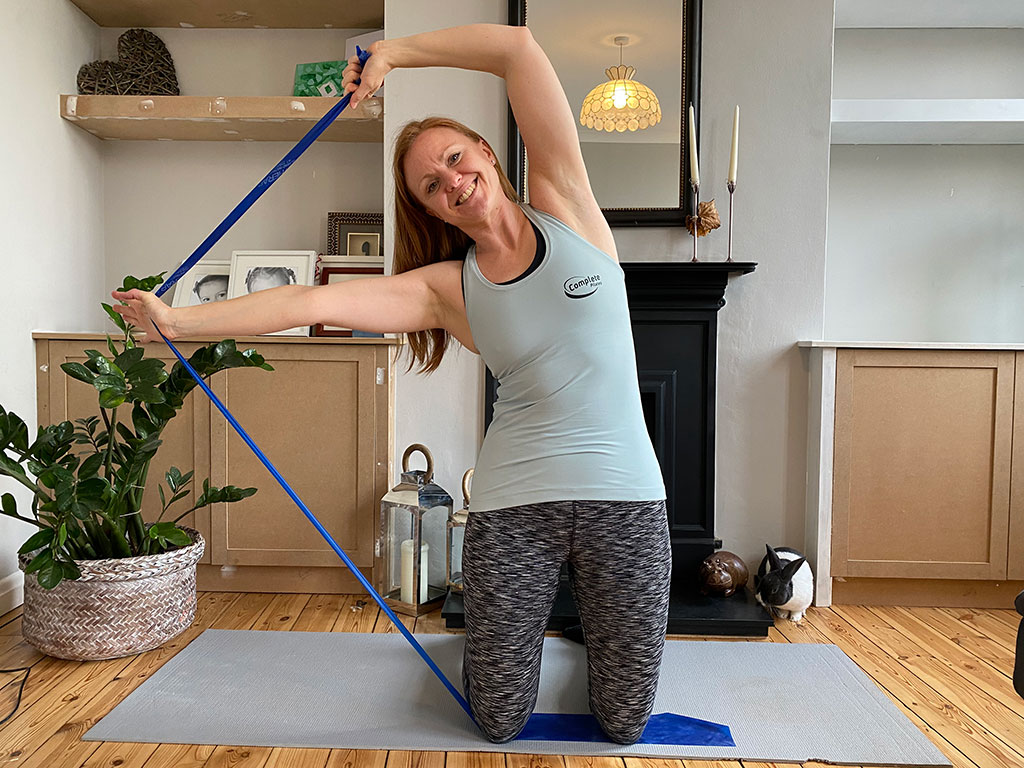
3. Kneeling Arms Triceps
This is one of our favourite at home tricep exercises which not only challenges your stability but also your triceps strength!
Kneel on the long band with your knees under your hip joints and come up into high kneeling. Remember to push your pubic bone forwards and stand into your feet throughout the movement.
Take your arms above your head and hold onto the band pulling wide.
As you exhale, reach up and over to come into a side bend. Try to keep your body facing forwards as you do this. Keeping the bottom arm reaching away and the band tight, slowly bend the top elbow over your head. Pause then return to straight.
To challenge your triceps, try to keep the upper arm still in space and lengthen around your elbow.
Repeat 10-15 times before changing to the other side.
Unless you have acute shoulder pain, this exercise is suitable for everyone. If you struggle with kneeling, you can add a pillow under your knees to make the ground softer.
It is a great at home tricep exercise to build strength in your arms.
Remember, the tighter the band, the harder this exercise!
Related Reading: Pilates Resistance bands movements
4. Kneeling Arms draw A Sword
The final variation in this kneeling arm series will start to work your rotator cuff more as well as your arm!
We are going to slow this movement right down when you do it to make it even more challenging.
First, kneel on the band and come up to high kneeling. Press your feet into the ground and send your pubic bone forwards.
Holding onto the band and start with your hand at the opposite hip joint. Draw your elbow towards the ceiling, pause and then rotate your fist towards the ceiling. Next, press your arm out diagonally until straight. Keep the elbow high and rotate your fist towards the floor, then move it back to your opposite hip joint.
Repeat 8-10x on each side.
This exercise is suitable for anyone. If you do have acute shoulder pain you can just start with the first movement only, or the first two.
This is a great at home exercise to get your whole arm working and use your abdominals at the same time.
5. Tricep Press Up
Our next at home tricep exercise is the tricep press which is a great challenge and amazing for arm strength!
You can modify this exercise if you need to by coming from a greater height such as leaning against a wall, chair or countertop. The closer you are to a plank position the harder the exercise will be.
Position your hands directly under your shoulders. They should feel quite narrow. Step out into a plank position with your feet together.
Inhale and keep the elbows close to your side, send them back towards your feet as low as you can control, maintaining the plank position at all times.
Repeat this 8-10x, challenging your height every time.
Because of the great modifications on this arm exercise this is suitable for everyone. We encourage you to change the height of the movement rather than going on your knees as this simply increases the challenge and load going through your arms rather than changing the movement.
Key Takeaways
- Arm strength is important for everyday life, helping with posture, lifting, carrying, opening doors and playing with children.
- You do not need heavy weights to strengthen your arms, as bodyweight, resistance bands and light household items can all be effective.
- Good arm strength also depends on shoulder and back strength, so exercises should train the upper body as a whole rather than only focusing on biceps and triceps.
- The triceps are especially important for pushing and weight-bearing movements, making them useful for functional strength and Pilates progressions.
- Exercises should be modified if you have acute shoulder pain, and resistance should only be increased if your form stays controlled.
Join the newsletter
Good news stories, exercise tips and short classes. One email a month.
Conclusion
Arm exercises at home can be simple, effective and accessible. With just a resistance band, bodyweight or light weights, you can build strength through the biceps, triceps, shoulders and upper back without needing a full gym set-up.
The exercises in this blog, including prone W, T and I, kneeling arms salute, kneeling triceps, draw a sword and tricep press-ups, work more than just the arms. They also challenge posture, shoulder blade control, trunk stability and back strength, all of which are important for healthy upper body movement.
The key is to focus on quality and control. Increasing resistance can help you progress, but only if it does not change your technique. If you have shoulder pain or are recovering from injury, it is best to seek professional advice before starting.
Feeling Inspired
If you want to experience the Complete difference and discover the benefits of one-to-one or small group Pilates, book a session at one of our London or Norfolk studios today. Not able to make it to one of our studios? We've got online options to suit you anywhere, anytime.
Our physiotherapist-led Pilates studio in Chelsea, our Angel Pilates studio, our Pilates studio in City, and our Norfolk Pilates studio in East Anglia, offer a highly tailored approach to your Pilates training. Whether your goal is to manage a health condition, rehabilitate from an injury or to improve your strength and fitness, Complete Pilates is the studio for you.
Education is key
These blogs are designed to give information to everyone, however, it is important to remember that everyone is different! If you have not seen one of our therapists and have any questions about injuries, what you have read or whether this may be useful to you, please just ask. We are more than happy to help anyone and point you in the right direction. Our biggest belief is that education is key. The more you understand about your injury, illness and movement, the more you are likely to improve.
If you are not sure whether this is for you, simply get in touch. We are here to help!
FAQs
Can I strengthen my arms at home without weights?
Yes, you can strengthen your arms at home using bodyweight, resistance bands or light household items such as tins or bottles. Exercises like tricep press-ups, banded arm work and prone arm lifts can all be effective. It is important to remember that if you are really strong to start with you are likely going to need more weight then you can get at home. However, if you are starting from less activity this is a very effective method of making it quick and accessible to begin to build arm strength at home.
What are the best Pilates arm exercises to do at home?
Good Pilates arm exercises include prone W, T and I, kneeling arms salute, kneeling triceps, draw a sword and tricep press-ups. These exercises help strengthen the arms, shoulders and upper back. Anything that you can do weight bearing will help strengthen the arms and shoulders quickly.
Do arm exercises help posture?
Yes, arm exercises can help posture when they also strengthen the shoulders, shoulder blades and upper back. Stronger upper body muscles can help support a more upright and comfortable position.
What muscles do arm exercises work?
Arm exercises commonly work the biceps and triceps, but they also involve the shoulders, rotator cuff, shoulder blades, upper back and trunk. This is why Pilates arm exercises often feel like whole upper body work.
Who should avoid these arm exercises?
If you have acute shoulder pain, a recent shoulder injury or are recovering from surgery, you should seek advice before starting from your physiotherapist or surgeon. Exercises can often be modified, but the right variation will depend on your symptoms and stage of recovery.
Published 2 Dec 2020 · Updated 16 Jul 2026