
Pilates Dart Exercise – Your Step by Step Guide with Video!
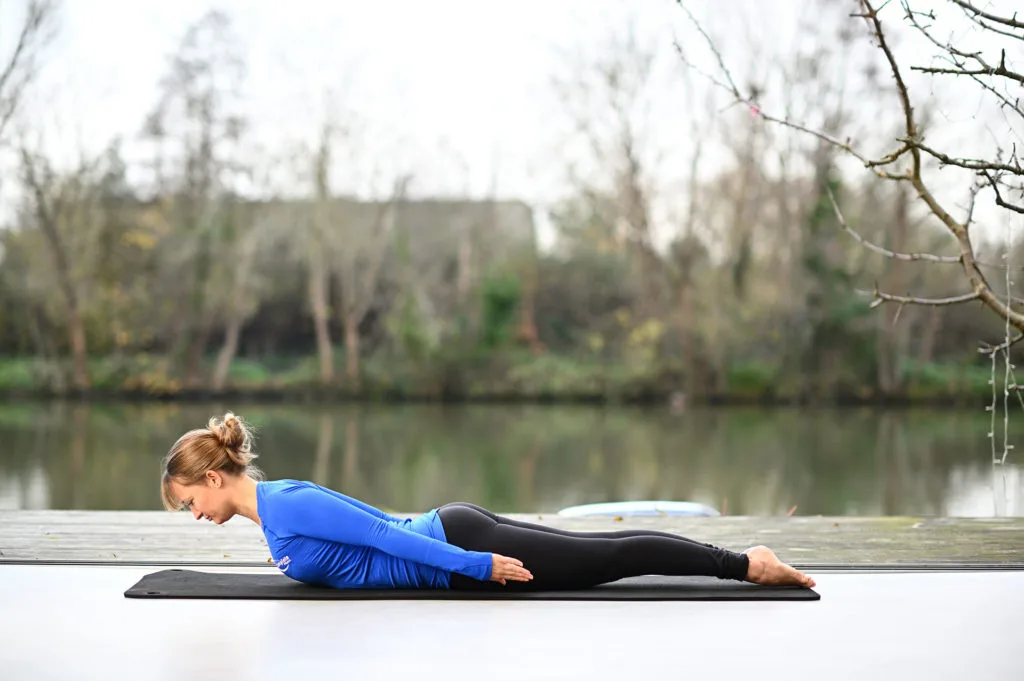
Do you get back pain or are scared to feel your lower back when working out? Do you sit at your desk a lot or want better posture? Or are you simply looking to get a stronger back?
Strengthening your back muscles can help prevent injuries occurring and ensure that your entire body works smoothly, both during daily movements and during exercise. It will also improve your posture as these are the muscles which help to hold you up against gravity.
The dart exercise is a Pilates mat exercise which is an excellent way to help in strengthening, supporting a healthy spine and protecting your back. The dart exercise is frequently recommended to people who suffer from back pain as it strengthens the back extension muscles in both the upper and lower back.
Our back muscles are some of the largest in the body therefore if you want to perform better in sport or have a better posture you need them to be strong so that you can hold yourself up better.
In this article, we’ll be discussing:
- What is the Pilates dart exercise?
- How to do the dart exercise?
- What are the benefits of the dart exercise?
- Who is the dart exercise suitable for / not suitable for?
What is the Pilates Dart Exercise?
The Pilates dart exercise is a simple but effective way to help strengthen the back, improve your posture and help the core function better too.
It’s also great if you have back pain as according to recent figures, 1 in 6 people in the UK suffer with back pain. The Pilates dart is commonly recommended by physiotherapists, Pilates instructors and personal trainers for people who have back pain as it helps strengthen the entire extensor system including the legs, not just the upper and lower back.
Once you have obtained strength and stability by doing the dart you can build on this exercise by doing more advanced Pilates exercises such as swimming, swan rocker or dive and double leg kick.
How to do the Dart Exercise?
- Firstly, lie on your stomach with your arms down by your sides, palms facing up and your forehead resting on the floor with your feet slightly apart.
- Allow your nose to hover off the floor so the tip of it is still facing the floor. This will start to activate your neck muscles.
- Press your pubic bone into the floor and reach your legs out long behind you. Even your feet should be working here!
- As you inhale, reach your hands towards your feet and feel your shoulder blades move towards each other. Allow your upper back to come up off the floor into extension, keeping the pubic bone pressing into the mat
- Press your feet into the floor and keep your arms and legs straight.
- Pause at the top and exhale, trying to stay high. Inhale again, coming up a little further and exhale to return to the floor.
- Repeat the exercise, changing your breath around to see which facilitates your movement better
Dart Exercise
★ It isn’t about how high you come up but the quality of movement. Generally, this means your lower ribs will stay on the floor. Try to keep your feet on the floor and legs straight. You should feel your legs working as well as your feet!
★ Allow your hands to face your torso as you are coming up to encourage external rotation of your shoulders. This will help keep the shoulders open.
★ Try to look only slightly forwards towards the top of your mat rather than straight in front of you.
★ Mix up your breathing and see whether your inhale or exhale helps to lift you or challenges you to stay up there. It is really important to mix between them to keep your body guessing!
What are the Benefits of Dart Exercise?
Dart exercise benefits include:
- Strengthens all the muscles in your back. These muscles include large muscles such as erector spinae, multifidus and glutes to name a few. It also strengthens the muscles in your legs such as your hamstrings. It builds strength and stability in and around the pelvis
- Improves your overall posture and mobility into extension
- Provides ease with movements that may cause pain, such as bending, twisting, or lifting
- Helps build strength to be able to do more advanced back strengthening exercises safely

Who is the Dart Exercise Suitable for?
As outlined above the dart exercise is suitable for anyone who is looking to improve their posture, routine training for injury prevention and back strengthening and it can also help deal with back pain as part of rehabilitation. It is also a brilliant exercise if you have been diagnosed with osteoporosis.
It’s especially great as it can help performance in many sports, such as rock climbing, swimming, boxing and heavy weight training.
Working out your back helps to stretch and strengthen the muscles that support its structure. The back muscles bolster the vertebrae disks, ligaments and facet joints. If your back muscles are weak, your spine is less supported and it may become vulnerable to pain. This will also counteract our typical daily activities which involve sitting and flexing a lot!
Back training can help to prevent common injuries that can happen when doing sports and daily chores — such as when moving furniture, hoovering or picking something up from the floor.
Who is Dart Not Suitable for?
It's best to avoid this exercise if you should not lie on your front, for example if you are in your third trimester of pregnancy. If you have a back or neck injury then always speak to your GP or physiotherapist as they can tell you if this exercise is appropriate for you. If you feel any pain, it’s often best to stop the exercise and ask for help before continuing.
If you notice your form is beginning to suffer then remember this can lead to injury. If dart isn’t working for you then you should consult with an exercise specialist such as a Clinical Pilates Instructor for individual, tailored advice.
Why do a Dart?
Essentially the dart exercise is ideal if you are looking to strengthen your back and help in your everyday day-to-day life and activities. You’ll function better and get stronger.
Remember, if you have a history of back problems, consult your doctor or a physiotherapist before proceeding.
If you would like more information on the dart or any Pilates back strengthening exercises, then our team of clinical Pilates instructors here at Complete Pilates are here to help. We are all trained to safely treat clients and create manageable, on-going exercise plans to keep you healthy.
Get in touch online or contact us on 0203 764 5668 create clickable link for further information.
What Our Experts Say
The dart is one of the foundational Pilates exercises we use to improve spinal strength and posture. Rather than focusing on how high you lift, concentrate on creating length through the spine and activating the muscles that support it. Performed well and progressed appropriately, the dart can be an excellent exercise for both injury prevention and back pain rehabilitation.

Conclusion
The Pilates dart may look simple, but it's one of the most effective exercises for building a stronger, more resilient back. Whether your goal is to improve posture, reduce your risk of injury, manage back pain or enhance sports performance, practising the dart with good technique can provide long-term benefits. As with any exercise, quality of movement should always come before quantity, and professional guidance can help ensure you're progressing safely.
Key Takeaways
- The Pilates dart is one of the best exercises for strengthening your back. It targets the muscles that support your spine, helping to improve posture, stability and overall movement.
- Strong back muscles help prevent pain and injury. Building strength through the upper back, lower back, glutes and hamstrings can reduce the risk of injury during everyday activities and sport.
- Technique is more important than height. Focus on controlled movement, maintaining good alignment and activating the correct muscles rather than lifting as high as possible.
- The dart exercise can support back pain rehabilitation. When prescribed appropriately, it helps improve spinal support, making daily movements such as bending, lifting and twisting more comfortable.
- Not every exercise suits everyone. If you have a current back or neck injury, are pregnant, or experience pain during the exercise, seek advice from a physiotherapist or Clinical Pilates instructor before continuing.
Join the newsletter
Good news stories, exercise tips and short classes. One email a month.
Feeling Inspired?
If you want to experience the Complete difference and discover the benefits of one-to-one or small group Pilates, book a session at one of our London or Norfolk studios today. Not able to make it to one of our studios? We've got online options to suit you anywhere, anytime.
Our physiotherapist-led Pilates studio in Chelsea, our Angel Pilates studio, our Pilates studio in City, and our Norfolk Pilates studio in East Anglia, offer a highly tailored approach to your Pilates training. Whether your goal is to manage a health condition, rehabilitate from an injury or to improve your strength and fitness, Complete Pilates is the studio for you.
Education is Key
These blogs are designed to give information to everyone, however, it is important to remember that everyone is different! If you have not seen one of our therapists and have any questions about injuries, what you have read or whether this may be useful to you, please just ask. We are more than happy to help anyone and point you in the right direction. Our biggest belief is that education is key. The more you understand about your injury, illness and movement, the more you are likely to improve.
If you are not sure whether this is for you, simply get in touch. We are here to help!
FAQs
Published 14 Jul 2021 · Updated 14 Jul 2026