4 Benefits of Foam Rolling
When we think of the benefits of foam rolling, we often think about relieving muscle tightness and soreness.
The research on the effect of foam rolling on muscle flexibility and soreness is mixed, but a lot of people swear by it.
Join the newsletter
Good news stories, exercise tips and short classes. One email a month.
At Complete Pilates we think the benefits of foam rolling are more than just for muscle release.
Foam rollers come in different shapes and sizes. We tend to use the long (90cm) hard foam rollers. However, you can also get shorter ones and textured, or ridged, ones that are made specifically for muscle release.
The foam roller is made for applying direct pressure to muscles to give a self massage effect. The long rollers are also created for use in Pilates to provide an unstable surface to challenge your core control.
You can include foam rollers at any time in your workout, whether it be used in a warm up, in challenging your core, as recovery for your muscles or as a separate mobility session.
The best way to know how to use them is to understand the benefits and how they relate to your goals. You can discuss this with your Pilates instructor, physio or trainer.
In this article we discuss 4 key benefits of foam rolling.
Increase Range of Movement
Foam rollers are excellent pieces of equipment to help you get increased range of movement. This can be in assisting mobility exercises or using as a direct pressure and feedback to your body for where you want to get more movement from. You can see this in the this example below.
Thread Needle Stretch
You can use foam rollers to assist you in exercises such as in this example of thread needle stretch. Using the ease of rolling with your hand helps you to relax into this rotation stretch for your thoracic spine. It reduces the need to force the movement and makes it more fluid.
Rest your hand on the roller and see how far you can reach the foam roller away from you.
Related reading: Benefits of thread the needle pose
Challenge Stability
To move efficiently, and remain injury and pain-free, we need to have good stability through our trunk. One of our main Pilates principles is core control. One of the benefits of the foam roller is to give an unstable surface to challenge your stability. Lying on the foam roller length ways along your spine means you must work harder through your core to keep your body stable in a neutral position.
Try this exercise to challenge the abdominals and your overall trunk stability.
Dead Bugs on the Foam Roller
Lie with your head and tail bone on the roller. Find your neutral spine position and rest the hands lightly on the mat next to you.
Stand into one foot and float the other leg up to table top. This movement should come from the hip joint with the pelvis and spine staying in neutral. If you can maintain this position and dissociate your hip you will automatically activate the abdominals and challenge your stability.
Alternate legs and try repeating 12 on each side.
Improve Posture
A large number of people who come to the Pilates studio will state that improving their posture is a goal. The foam roller can be a really useful tool to use to assist with this. We know that posture relies on a number of factors including range of movement and muscle strength endurance. Often when we sit for a long time we become flexed through our thoracic spine and tight through the front of our shoulders. You can use the foam roller to assist with spinal extension and actively opening the front of your shoulders. Try this exercise below.
Thoracic Extension
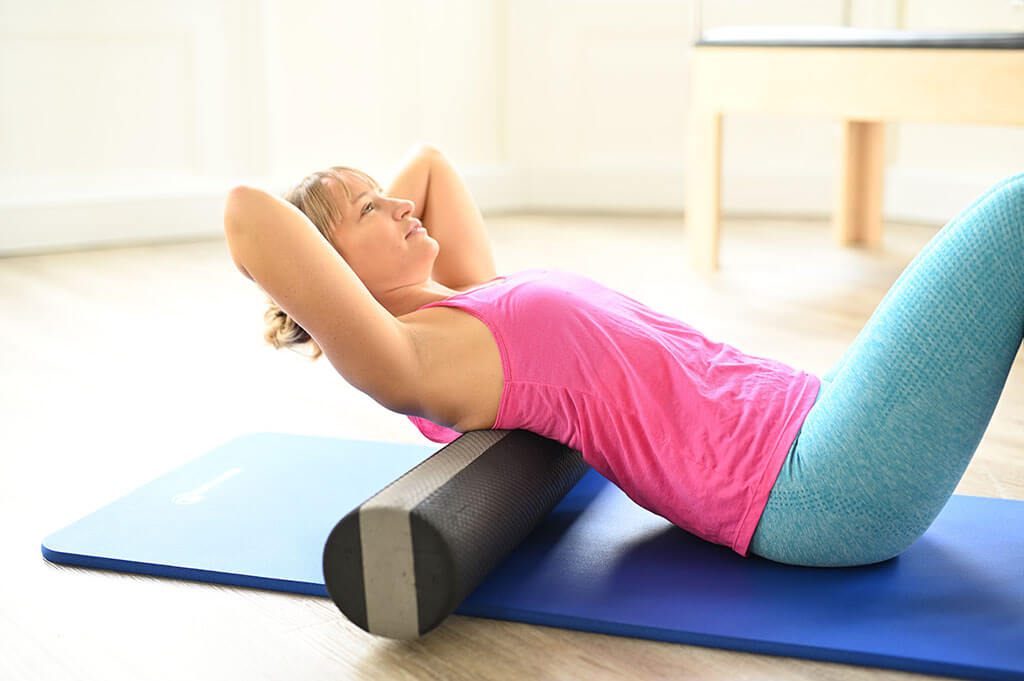
In this exercise you are using the foam roller to give you a pivot point for spinal extension. The foam roller gives you feedback to where you are wanting to get more movement. The direct pressure may help your muscles to relax and the joints to move further.
Find the section of your spine where you feel stiff. Stabilise through your pelvis and lower back as you ease back over the roller and use your breath to increase the range of movement.
Ease Muscle Pain and Aid Recovery
This is the benefit of foam rolling that many people think about and practice. Foam rollers can be used to give a self myo-fascial release technique. This is like having a soft tissue therapy treatment to aid recovery of your muscles after a gym workout or run.
The research on how this works and whether it is effective is mixed. There is some research to show that it gives short term effects on the extensibility of the tissues and the pressure pain threshold (sensitivity) of the tissues which may help with recovery.
There is also some research that shows foam rolling can reduce arterial stiffness which could increase the blood circulation and help recovery.
This often comes down to what you find works for you give it a try and see how you feel.
Foam Rolling Quadriceps
Lying on your front you can do this on both legs together or one one leg at a time. Support yourself with your hands taking the weight through the thighs onto the foam roller. Use the arms and trunk to move yourself forwards and backwards so that you roll through the full length of the quads. You can change the angle slightly so that you focus more on to the medial and then lateral portions of the muscle.
How to Use a Foam Roller Safely
Foam rolling is a safe addition to any exercise program. As you can see from these 4 benefits of foam rolling there are different ways to add it with different goals.
If you are using foam rolling for muscle release this is safe as long as you do not have any direct acute muscle injury. You do not want to be rolling over bruised or inflamed tissue, follow the advice of your physio here.
Have a go at the exercises we have included in this article. There are many more variations of exercises that you can do with the foam roller if you have one at home. The best idea is to just give it a go and see how your body feels, remember our bodies respond well to change and progression so this could be a great way to progress your stability or mobility work and achieve your goals.
Complete Pilates is a physio-led equipment Pilates company with studios in London and online.
We specialise in one to one Pilates focusing on the individual and bespoke programmes to achieve your goals.
We run one to one sessions in the studios in Chelsea and the City as well as one to one and group classes online.
What Our Experts Say
Many people think of foam rolling purely as a way to relieve tight muscles, but it can be so much more than that. We regularly use foam rollers in Pilates to improve movement quality, challenge balance and core control, and encourage better posture. Like any piece of equipment, the greatest benefits come from using it with a clear purpose and choosing exercises that match your individual goals.

Conclusion
Foam rolling is far more than a recovery tool. Whether your goal is to improve mobility, strengthen your core, enhance your posture or reduce muscle tightness after exercise, a foam roller can become a valuable part of your training programme. Understanding how and when to use it allows you to tailor your routine to your individual needs and get the greatest benefit from every session.
Key Takeaways
- Foam rolling offers more than muscle release. It can improve mobility, challenge core stability, support posture and aid recovery, making it a versatile addition to your exercise routine.
- Foam rollers can help increase range of movement. They provide support and feedback during mobility exercises, helping you move more freely and comfortably.
- An unstable surface challenges your core. Exercises performed on a foam roller require greater balance and trunk control, helping to improve stability and movement efficiency.
- Foam rolling can support better posture. By encouraging thoracic mobility and opening the front of the shoulders, foam rollers can help counteract the effects of prolonged sitting.
- Use foam rollers safely and purposefully. Choose exercises that match your goals and avoid rolling directly over acute injuries or inflamed tissues. If in doubt, seek advice from a physiotherapist or Pilates instructor.
Feeling Inspired?
If you want to experience the Complete difference and discover the benefits of one-to-one or small group Pilates, book a session at one of our London or Norfolk studios today. Not able to make it to one of our studios? We've got online options to suit you anywhere, anytime.
Our physiotherapist-led Chelsea Pilates studio, our Angel Pilates studio, our Pilates studio in London City, and our Norfolk Pilates studio in East Anglia, offer a highly tailored approach to your Pilates training. Whether your goal is to manage a health condition, rehabilitate from an injury or to improve your strength and fitness, Complete Pilates is the studio for you.
Education is Key
These blogs are designed to give information to everyone, however, it is important to remember that everyone is different! If you have not seen one of our therapists and have any questions about injuries, what you have read or whether this may be useful to you, please just ask. We are more than happy to help anyone and point you in the right direction. Our biggest belief is that education is key. The more you understand about your injury, illness and movement, the more you are likely to improve.
If you are not sure whether this is for you, simply get in touch. We are here to help!
FAQs
1. What are the main benefits of foam rolling?
Foam rolling can help improve range of movement, challenge core stability, support posture and aid muscle recovery. While many people use it for self-massage, it is also an effective tool for mobility and Pilates-based exercises.
2. Should I foam roll before or after exercise?
Both can be beneficial. Before exercise, foam rolling can help prepare your body by improving mobility and movement quality. After exercise, it may help reduce feelings of muscle tightness and support recovery.
3. Can foam rolling improve posture?
Foam rolling exercises that encourage movement through the thoracic spine and open the front of the shoulders may help counteract the effects of prolonged sitting and contribute to improved posture when combined with strengthening exercises.
4. Is foam rolling safe for everyone?
Foam rolling is generally safe for most people. However, you should avoid rolling directly over acute injuries, bruised or inflamed tissue, and seek advice from a healthcare professional if you have an existing injury or medical condition.
5. How often should I use a foam roller?
Foam rolling can be incorporated into your routine several times a week or even daily, depending on your goals. It can be used as part of your warm-up, during Pilates or strength training, after exercise for recovery, or as a standalone mobility session.
Published 28 Nov 2020 · Updated 14 Jul 2026